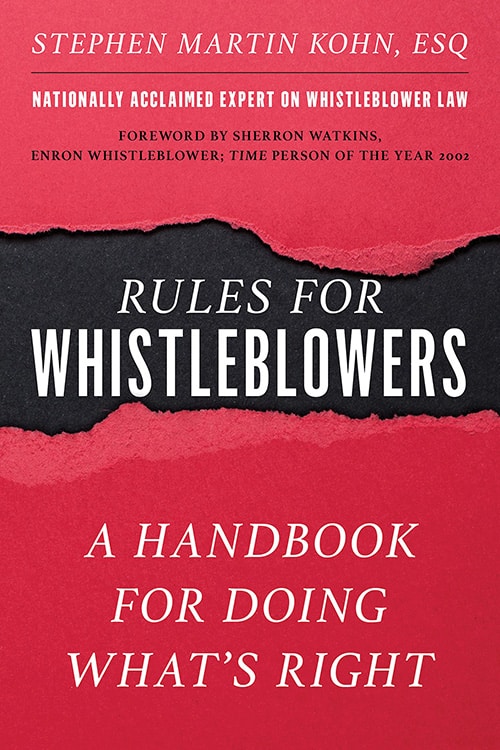

National Whistleblower Center Announces FREE DOWNLOADABLE Updates to Federal Whistleblower Law Book

The National Whistleblower Center issued the following public service announcement today:

-----------------------------------------------

National Whistleblower Center Releases Update to
Federal Whistleblower Laws and Regulations Book


August 26, 2008. Washington, D.C. The National Whistleblower Center announced today that it has released an updated version of its publication, Federal Whistleblower Laws and Regulations. This publication was first made available as a free download in May 2007 and is the only legal treatise encompassing all federal laws protecting whistleblowers. Federal Whistleblower Laws and Regulations contains the text of over 100 federal statutes and regulations, including the Sarbanes-Oxley corporate whistleblower law, the False Claims Act, the Whistleblower Protection Act and the newly passed Consumer Product Safety Reform Act.
 

This update publication is available immediately as a free PDF download from the National Whistleblower Center website. To download, please click this link: Federal Whistleblower Laws and Regulations.
 

For more information about the National Whistleblower Center visit www.whistleblowers.org

Washington Post Reports That Hundreds of Contracting Scandals are Not Being Investigated

If you do the math on a Washington Post story yesterday it turns out the paper reported on what amounts to 225 scandals.

The Justice Department told the Post there is a backlog of approximately 900 False Claims Act cases, and that the backlog could take years to unclog. Obviously the time involved can damage the ability to pursue even the most meritorious cases. Justice also told the Post that they reject about 75% of all filed FCA cases, and most of those have little merit. I would bet that quite a few of the cases rejected have some merit but why quibble over that? If there are 900 cases in the system and a quarter represent cases that should be pursued, that means there are 225 good cases of fraud stuck in a black hole. That means we have not one scandal but as many as 225 scandals, because each such case deserves priority treatment the Justice Department simply does not have the resources to handle. These 225 cases have to be relatively big and they likely involve major contractors who can continue to commit fraud against the United States. Of the remaining 675 in which the Justice Department may investigate and see no merit, the inability to kick them back to private attorneys quickly does not help.

Private Attorneys would at least like to clear their own backlog but they would also like the chance to pursue some of those cases. Justice may have legitimate reasons not to pursue a case a private attorney might take a chance on, but if the case waited three years for an initial determination very few whistleblowers will still have the resources, time and ability to continue the fight even if they are right.

But the fact is, according to Justice there must be at least 225 cases that have merit. How can we let this continue? We know. We know by Justice's own procedures that there must be some 225 cases of major fraud and nobody can even get to deal with them. That's a pandemic of fraud and we are not fighting the disease. Within those 225 cases that means, important safety concerns and governmental functions are being undermined by unscrupulous contractors. The contractors who profit from fraud gain a competitive advantage and push out honest contractors who want to do good work. Fraud is very profitable and if you can get away with it provides a great competitive advantage. Right now you can get away with it.

These aren't small cases. Nobody takes the trouble to file a False Claims Act case these days if they can't find at least millions in damages because by the time the Relator gets their share, it does not leave much for what now appears to be years and years of legal work. Billions of dollars of fraud are lost this way. The whole point of the FCA is to punish and deter fraud. How do you deter fraudulent activity when it is clear to everybody that the Justice Department does not have the people power to stop it?

At least some of the fraud must compromise vital government activity. More and more contracts are being used to do what we used to think of as inherently governmental functions. The very mail room in the Justice Department where these cases arrive is run by a private contractor now. Its scary to think about how dependent national security is on private contractors who can commit fraud in this environment. It is also hard to think of anything that corrodes our basic faith in government more readily than the extensive nature of this fraudulent activity.

The Post story blew the whistle (if you will pardon the expression) on the problem, but who are we to blame? Certainly not the career Justice lawyers who are overworked beyond reason. Assistant United States Attorneys working on False Claims Cases have dockets of 60 cases. Open the file on each case and look at it and a whole week is gone. Main Justice has only 75 lawyers they can assign to these cases. The people trying to deal with these cases want to investigate the cases responsibly and they want to win even in a judicial environment hostile to whistleblowers. There are simply not enough attorneys and investigators to go around.

Justice has approximately the same number of attorneys working on these cases that they did in the early 1990s when far fewer cases were brought, far less government functions were handled by private contractors and when the kinds of cases were not generally as complicated or big. How do you investigate a fraud, which may have occurred in Afghanistan or Iraq? How does the same lawyer become an expert on Medicare regulations AND Defense contract procedures overnight?

Here's a starting suggestion. Hire all the lawyers. There has never been a better time. The only area of law experiencing growth right now besides fraud is bankruptcy, so there should be plenty of attorneys looking for work. I don't care if the Justice Department has to appoint special attorneys general to investigate one case or if they want to just take the first 750 resumes that come across the door, we have to do something. There are private law firms that have that many attorneys. Why is it so outrageous for the federal government to hire enough attorneys and investigators to deal with a serious issue of national importance, which would, if they did it save as opposed to cost tax money? We hear lots of talk about cutting waste fraud and abuse in an election year.

We don't hear much talk of a bill to specifically expand Justice by enough lawyers and more investigators to fight fraud. What else could the government spend money on which would certainly return money to the taxpayer directly and also improve the quality of work done for the government? Here is a law that actually gives investigators and lawyers at least some chance of fighting fraud in a courtroom. Now if we could only get enough people involved in bringing the cases there we might be able to find out what is going on in those 225 scandals sitting on a shelf in a Government office.

Senate Committee Schedules Thursday Vote on False Claims Act Correction Act (S.2041)

UPDATE: THE COMMITTEE VOTE ON S.2041 HAS BEEN POSTPONED. AS OF TODAY (3/13/08) AT 2PM IT HAS NOT BEEN RESCHEDULED. MORE INFO WILL BE POSTED AS WE RECEIVE IT...


The Senate Judiciary Committee is scheduled to vote on S.2041, The False Claims Act Correction Act, in a meeting this Thursday. The bill is designed to reverse key federal court decisions which have undermined the intent of the FCA. This legislation has been championed by committee member Sen. Charles Grassley, and was the subject of a hearing on Feb 27, which I attended and blogged here.

Senator Grassley, Others File Briefs in Supreme Court Whistleblower Case

Briefs were filed yesterday in the Supreme Court case Allison Engine Co., Inc. v. United States ex rel. Sanders (Docket no. 07-214). This case will decide whether corporations and individuals who receive government contracts are legally required by the False Claims Act to "present" their claim for payment to a government agency, or if they can evade liability under the FCA by routing these claims through a surrogate, such as a subcontractor.


The Petitioners' and Respondents' briefs were filed yesterday, as well as Amicus briefs, including for the Respondents Amicus Curiae briefs from Senator Grassley and Taxpayers Against Fraud. (Thanks to TAF for these briefs).


View the National Whistleblower Press Release on this issue here

False Claims Act Legislation, HR.4854, Introduced in Congress

Another big legislative announcement! We received word today that the False Claims Act Amendments Act of 2007 has been introduced in the House of Representatives by Congressman Howard Berman. The bill number is HR. 4854.


This bill is designed to be companion legislation for the False Claims Act Correction Act of 2007, which was introduced in the Senate in September of this year by Senators Grassley, Leahy, Durbin and Specter. The legislation is intended to correct loopholes in the False Claims Act, a law which permits private citizens to file suit against contractors who defraud the federal government. 


The NWLDEF and the National Whistleblower Center fully support this legislation, and urge Congressional Leaders to make it a priority when they return from recess.  

$670 Million False Claims Act Settlement from Merck Flying Under the Radar

I would like to take this opportunity to remind everyone that the False Claims Act is supposed to be a Whistleblower law. Something is strange when there's a 670 Million Dollar settlement under this law and it’s actually pretty hard to find out what happened. (The only reports I could find were in the Corporate Crime Reporter and a paragraph five mention in this Associated Press article)


There's a lot of good news in the fact that Merck had to pay this money, but we'll have to wait for all the details because it seems many of the documents are still under seal. False Claims Act Plaintiffs always have a hard time adjusting to the idea that they have to keep their mouths shut to let the Government investigate their claims. In this case, the Government should be congratulated - they got a huge result. Yet one of the points of the law is to deter the type of behavior Merck engaged in, and it's hard to see how keeping the results quiet does that.


We were able to find one court document, the Complaint filed in Nevada under that State's False Claims Act. If that complaint can be believed, and there are 670 million reasons to give it credibility, Merck went about "increasing market share" as they call it, pretty much the way a drug pusher does. Only drug pushers don't get the US taxpayer to underwrite sales.


The complaint filed in Nevada district court outlines a scheme to defraud the taxpayer. Merck essentially gave away their drugs, drugs for chronic conditions, to hospitals so that patients would be dependent on the prescription when they left the hospital. Then Merck charged higher prices when the patient left. Only problem is that by discounting drug away earlier they were supposed to report that as the new price of the drug and re-imburse the government accordingly. Ooops. You can't say the pill is 10 cents in the hospital but costs 2 dollars when the patient leaves and get two dollars per pill from the government which pays the bills each time.


In a special irony, one of the drugs whose "market share" this scheme Improved was Vioxx. So now Merck has more Vioxx liability for that drug's cardiac problems than if they marketed the drug legally. That would almost be funny if it didn't put so many patients' lives at risks.


Anyway, the US Department of Justice is to be congratulated for winning such a huge settlement. The Lawyers who won the case and certainly the Plaintiff who brought it have all earned their reward. I just wish that instead of keeping everything quiet everybody would do a little more bragging. Get all the documents out of seal and tell the world that the False Claims Act works to recover funds stolen from the government even in complex schemes. Let's encourage the whistlebowers to report fraud as the False Claims Act was enacted to do. When you win $670 Million, its time to tell the world.


False Claims Act / Qui Tam FAQ

Warning regarding litigation under the False Claims Act

The False Claims Act has one of the strongest whistleblower protection provisions in the United States. However, it has many complicated components and requirements which can harm any person that pursues such a claim without counsel. Due to the potential for a significant financial recovery, it is usually possible to retain an attorney for such an action. If, after reviewing this section, you believe that you may have an action arising under the False Claims Act and need an attorney, please complete our Attorney Referral Service / Report Fraud Now form.


What is the False Claims Act (Qui tam)?

The False Claims Act is 31 U.S.C. Sections 3729 through 3733. Qui tam, under the False Claims Act, allows persons and entities with evidence of fraud against federal programs or contracts to sue the wrongdoer on behalf of the United States Government. In Qui tam actions, the government has the right to intervene and join the action. If the government declines, the private plaintiff may proceed on his or her own. Some states have passed similar laws concerning fraud in state government contracts.


What Actions Are Considered Violations under the False Claims Act?

  • Knowingly presenting (or causing to be presented) to the federal government a false or fraudulent claim for payment 
  • Knowingly using (or causing to be used) a false record or statement to get a claim paid by the federal government 
  • Conspiring with others to get a false or fraudulent claim paid by the federal government 
  • Knowingly using (or causing to be used) a false record or statement to conceal, avoid, or decrease an obligation to pay money or transmit property to the federal government.

Who Can File a Qui tam Action?

Any persons or entities with evidence of fraud against federal programs or contracts may file a Qui tam lawsuit. If the government or a private party has already filed a False Claims Act lawsuit based on the same evidence as you, you cannot bring a lawsuit.


Where Should a Qui tam Action Be Filed?

A qui tam action must be confidentially filed under seal in federal district court in accordance with the Federal Rules of Civil Procedure. A copy of the complaint, with a written disclosure statement of substantially all material evidence and information in the plaintiff's possession, must be confidentially served on the U.S. Attorney General and the U.S. Attorney for the district in which the complaint is brought. An action under the False Claims Act must be filed, in camera and under seal. The complaint and its contents must be kept confidential until the seal is lifted. The complaint is not served on the defendant. If the plaintiff violates the provisions of the seal, his or her complaint could be dismissed.


What Are the Civil Penalties Under the False Claims Act?

Violators of the False Claims Act are liable for three times the dollar amount that the government is defrauded and civil penalties of $5,000 to $10,000 for each false claim.

A qui tam plaintiff can receive between 15 and 30 percent of the total recovery from the defendant, whether through a favorable judgment or settlement. To be eligible to recover money under the Act, you must file a qui tam lawsuit. Merely informing the government about the violation is not enough. You only receive an award if, and after, the government recovers money from the defendant as a result of your suit.


What Are the Statutes Of Limitations for Filing a Qui Tam Lawsuit?

Under the False Claims Act, an action must be filed within the later of the following two time periods:

  1. Six years from the date of the violation of the Act; or 
  2. Three years after the government knows or should have known about the violation, but in no event longer than ten years after the violation of the Act.

(One Circuit Court has interpreted the second provision as requiring that the action be filed not later than three years after the qui tam plaintiff rather than the government knows, or should have known about the violation.)


What Are the Whistleblower Protection Provisions in the False Claims Act?

Under Section 3730(h) of the False Claims Act, any employee who is discharged, demoted, harassed, or otherwise discriminated against because of lawful acts by the employee in furtherance of an action under the Act is entitled to all relief necessary to make the employee whole. Such relief may include:

  • Reinstatement 
  • Double back pay 
  • Compensation for any special damages including litigation costs and reasonable attorneys' fees.

You should be aware, however, that the scope of whistleblower protection under Section 3730(h) is an issue that currently divides the courts.

Many states have wrongful discharge or other employment laws that may provide other remedies for such discrimination.

The Statute of Limitation for filing a FCA retaliation case is different then that for filing a qui tam recovery case. Retaliation case must be filed under the statute of limitation applicable to the similar state wrongful discharge action.


What about State False Claims Acts?

Due to the success of the Federal False Claims Act, a growing number of states including New York, California, and Virginia, have enacted State versions of the False Claims Act. These laws permit whistleblowers to recover a “finders fee” for reporting fraud in state, local and municipal contracting.


What about Tax Fraud?

In 2006, Congress amended the Internal Revenue Code to permit whistleblower to obtain a reward for reporting tax fraud.


How can I get help?

If you need to speak to an attorney, you can contact us using the NWLDEF’s Attorney Referral Service / Report Fraud Now form.