
SIGN UP NOW
Follow the NWC on Twitter!Follow the NWC on Facebook!

NWC seminar on Dodd-Frank a huge success

Sean X. McKessy and NWC founders

David Colapinto, Stephen Kohn, Sean McKessy and Michael Kohn.
Photo by Lindsey Williams.

Yesterday, the National Whistleblowers Center (NWC) road trip of seminars came to Washington, DC, to spread the word about new opportunities for whistleblowers under the Dodd-Frank Wall Street Reform and Consumer Protection Act. "This was the best continuing legal education I've had in 17 years," attorney Don McKenna told me. In fairness, this is in part because the law has never been so good for whistleblowers. "Dodd-Frank's employee protections are the Cadillac of whistleblower protections," NWC Executive Director Stephen M. Kohn said. However, it was also because of the star-studded faculty. The seminar marks the first appearance of Sean X. McKessy to a "whistleblower-friendly" crowd since he became Director of the Security and Exchange Commission (SEC) Office of the Whistleblower. There was more than one joke about McKessy's background working for corporations. Answering corporate concerns about whether the SEC's rules would undercut internal compliance programs, McKessy said, "I would know if something we [the SEC] do would destroy internal compliance as we know it." McKessy explained how he read through 305 pages of comments to the SEC whistleblower rules. He did so with an eye toward the 40% of frauds that go undetected. McKessy announced that on August 12, 2011 (the day the SEC whistleblower rules go into effect), his office will launch a new web page. The page will have a form for on-line whistleblower submissions. He said his office would be looking for submissions that are "specific, timely and credible." His main message, "We are open for business, and whistleblowers are welcome at the SEC."

Donna BoehmeDonna Boehme made a presentation on corporate compliance and interface with the new rules. Boehme (rhymes with "Rome") is an internationally recognized authority in the field of organizational compliance and ethics. She is currently a Principal of Compliance Strategists LLC. She serves on the boards of the RAND Center of Corporate Ethics and Governance, the Rutgers Center for Government Compliance & Ethics, the Society of Corporate Compliance & Ethics, and South Texas College of Law - Corporate Compliance Center, and is Program Director for the Conference Board Council on Corporate Compliance and Ethics. She previously served as Group Compliance and Ethics Officer for BP plc (London). Boehme said that she felt the SEC found a good balance between internal compliance and SEC enforcement action and is giving employees a choice of whether to report internally first depending on how they feel about the company's internal compliance program. "Employees really know if a company's compliance program is serious." One good clue: to whom does the chief compliance officer report?  If the answer is the CEO, CFO, general counsel, or HR director, then the program does not have the independence required for the compliance mission. A company's senior people are the typical wrongdoers, she notes. The correct answer is the board. "Expectations for the board are changing, and real board training should be the next wave," she urges. "Not all internal compliance programs are equal," Boehme observed. The process of developing a program employees will trust "allows companies to do some soul searching." Boehme, and her colleague Michael Greenberg, wrote an op-ed for Bloomberg Government last month on the SEC whistleblower rules. "Compliance and internal audit people often get in trouble for doing their job too well," Boehme told us.

Dean Zerbe and David ColapintoDean Zerbe (pictured with David Colapinto) is special counsel to NWC, and a principal of The Alliant Group. He formerly worked for Sen. Charles Grassley as chief investigator, and as counsel to the Senate Finance Committee.  In that capacity, he wrote the law creating the IRS whistleblower reward program. "The SEC rules came out a lot better because of the National Whistleblowers Center," Zerbe said, noting that the SEC cited NWC's comments over 40 times. "Thank them for the rule being much better." Zerbe's main point, however, was that, "the people whose hands are dirty are the ones who have the specific, timely and credible information." He explained that the phrase "substantially directed, planned, or initiated the violation" is a term of art that refers to the leader of the law-breaking group. Anyone who was following the leader should not suffer a reduction in any reward because they are precisely the group that whistleblower rewards were meant for. Moreover, since becoming a whistleblower can mean a person's career is over, rewards should not be reduced. "To catch a big fish, you need to put a lot of bait in the water."

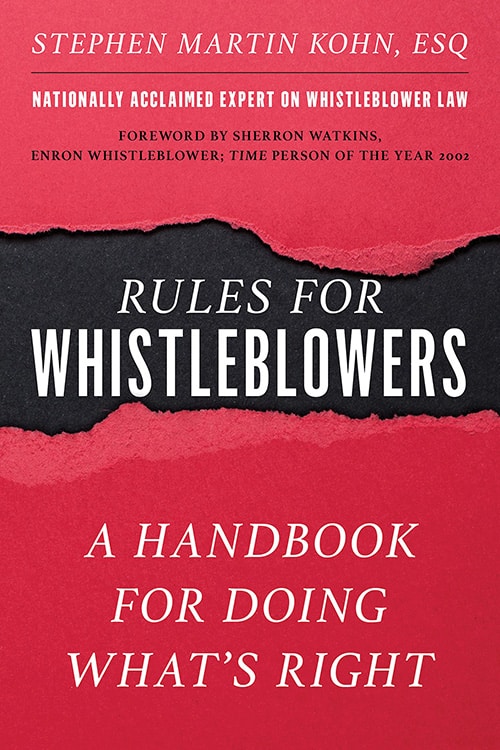
The NWC seminar tour makes its next stop in New York City on July 25, 2011, at 1:00 p.m. Stephen Kohn will be speaking at the Mid-Manhattan Library in New York City at 6:30 pm (EDT) that evening on his new book, The Whistleblower’s Handbook: A Step-by-Step Guide to Doing What’s Right and Protecting Yourself.

Stephen Kohn offered additional tips for whistleblowers and their advocates.

  • Noting that the SEC rule for anonymous whistleblowers requires that they be made through counsel, Kohn suggested that an attorney could review the documents available for submission and select those that well establish the whistleblower's claim while minimizing the risk of "fingerprinting." In "fingerprinting" a corrupt corporate manager would use the scope of a government investigation, and the documents relied upon, to narrow the group of suspected whistleblowers.
  • The SEC Rule 21F-4(b)(4)(v) allows internal auditors to submit their own whistleblower reward claims in three circumstances:

(i) a report to the Commission is necessary to prevent substantial harm to the entity or investors;
(ii) the entity is engaging in conduct that will impede our investigation; or
(iii) 120 days have elapsed.

  • The 120 day time limit will create a dilemma for corporate managers. If they fail to self-report a violation to the SEC within 120 days, their own internal compliance personnel can start filing their own whistleblower reward claims to the SEC.
  • Since the SEC rules count reports to internal compliance programs in determining who was the first to file, whistleblowers should preserve evidence of their submissions to internal compliance.

Sean X. McKessy added these points:

  • Each time the SEC completes an enforcement action for over $1 million, it must post a notice of the action on its web page. This posting starts a 90-day clock. During the 90-days, any whistleblower seeking a reward from this enforcement action must file a claim for it. His office will then review the claims and determine what rewards, if any, it can make from the enforcement penalty.
  • The SEC Office of the Whistleblower plans to begin posting notices of eligible SEC enforcement actions on August 12, 2011.
  • Those whistleblowers who submitted anonymous claims before August 12, 2011, must provide their lawyer with a signed TRC form [tips, complaints and reports] by October 11, 2011. Anonymous claimants filing on or after August 12, 2011, must provide their signed TRC from to their attorney before they file.
  • Since the SEC gets over 30,000 tips a year, his office will be relying on the SEC Office of Market Intelligence to perform a triage function. Everyone at the SEC is looking for a good case, so it is in the interest of the whistleblower to make a good submission. Good submission have detailed information about dates, names, documents and witnesses. "Give us the iceberg," McKessy urges.
  • Any written submission to the SEC on or before August 11, 2011, can qualify for a Dodd-Frank reward. However, whistleblowers must pay attention to the SEC notices of eligible enforcement claims and submit their claims for rewards before the 90 day time limit expires.
  • If there are multiple claimants for the same reward, the reward goes to the whistleblower who was first to file, either with the SEC or with the company's internal compliance program.  Don't sit around waiting for a fraud to grow.  Be the first to file. The TCR portal is linked here. It will be updated on August 12, 2011.
  • Rewards can be increased in size based on (1) the significance of the information provided, (2) the whistleblower's cooperation, (3) the extent of the SEC's "law interest" in the case, and (4) the whistleblower's cooperation with internal compliance.
  • Rewards can be reduced based on (1) the whistleblower's culpability in the violation, (2) undue delay in reporting, and (3) interference with internal compliance efforts.
  • When making a submission to the SEC, please disclose any other reports you have made.  For example, if you disclose that you have also filed an IRS whistleblower report, or a report to the Department of Justice, then the SEC can share your information with those agencies and coordinate enforcement actions.
  • If the SEC staff recommends an award of less than 30%, you have 30 days to request an opportunity to review the record and meet with the staff. Exercising both options is a good idea. The time to appeal to the Claims Review Board (CRB) is 60 days.
  • Denials of rewards, and rewards of less than 10%, are reviewable in U.S. Circuit Courts of Appeals.
  • Retaliation against a whistleblower is also a violation of the Securities Exchange Act. In addition to pursuing remedies from the Department of Labor, a whistleblower can ask the SEC to commence an enforcement action.
  • Don't expect fast action on whistleblower claims.  It will take time for the Office's staff of 7 to complete work on the rewards program.
  • Help spread the word that the SEC Office of the Whistleblower is open now for business.

Dean Zerbe adds:

  • When making a submission, ask when will be a suitable time to call back to discuss it again.
  • Fraud violations are often also tax violations. If someone is accepting a bribe, what are the odds that they will be reporting it on their tax return? File a whistleblower report with the IRS too.

Supplemental statutory material for the seminar is available here.

Donna Boehme's Resource Guide on Empowered Chief Ethics and Compliance Officer (CECO) Role

Sylvester wins at ARB in a victory for all whistleblowers

Steve Kohn, Kathy Sylvester, Pat McDermott

On May 25, 2011, the Department of Labor's Administrative Review Board (ARB) issued a major decision in favor of whistleblowers. In Sylvester v. Parexel International, ARB Case No. 07-123 (ARB May 25, 2011), the ARB held that a whistleblower only needs a "reasonable belief" of a violation to engage in protected activity under the 2002 Sarbanes-Oxley Act (SOX). The ARB makes clear that a whistleblower does not have to wait for a violation to actually happen, and need not inform management of the basis of that reasonable belief. Indeed, since SOX prohibits companies from violating rules of the Securities and Exchange Commission (SEC), a whistleblower can have a reasonable belief about a violation that has nothing to do with any fraud against shareholders. The ARB also rejects the idea that a SOX violation has to be "material" to form the basis of a whistleblower's "reasonable belief." The ARB has also freed whistleblowers of the unnecessary hurdle of "pleading" their claims under the high "Iqbal" standard.

The Sylvester decision is a significant departure from the decision of the prior administration. All those decisions that required protected activity to "definitively and specifically" implicate a violation of law are now out-of-date. Indeed, in separate concurring opinions, three of the four ARB judges specifically rejected the "definitively and specifically" standard since it is not in the statute.

When considered together with Brown v. Lockheed Martin Corp, ARB No. 10-050, ALJ No. 2008-SOX-49 (ARB Feb. 28, 2011) (no fraud against shareholders need be shown), and Johnson v. Siemens Building Technologies, Inc., ARB Case No. 08-032 (ARB Mar. 31, 2011) (SOX covers the employees of subsidiaries), the Sylvester decision marks a decided turn in favor of recognizing whistleblowers as servants of the public purpose and deserving of strong protection. The ARB is clearing away the hurdles that made SOX so difficult for whistleblowers during its first eight years.

Pictured above are Stephen M. Kohn, Kathy Sylvester and her attorney E. Patrick McDermott. Stephen Kohn co-wrote amicus briefs with me on behalf of the National Whistleblowers Center and Douglas Evans. Congratulations to Kathy Sylvester, her co-complainant Theresa Neuschafer, and their attorney, Patrick McDermott of Annopolis, Maryland. They have helped breath new life into SOX on behalf of future generations of whistleblowers.

ARB holds first oral argument in a SOX case

Today the Department of Labor's Administrative Review Board (ARB)ARB held its first oral argument in a case under the Sarbanes-Oxley Act (SOX). Last November, the ARB gave notice of today's oral argument, and invited interested groups to submit friend-of-the-court (or "amicus") briefs. The ARB asked the parties to address issues of how specific OSHA complaints have to be, whether Administrative Law Judges (ALJs) can grant motions to dismiss on the pleadings, and the nature of protected activity under SOX. A prior blog post covered the amicus briefs, including the briefs of the National Whistleblowers Center and Doug Evans. Pictured here are ARB Board Members Luis Corchado, Paul Igasaki (Chair), E. Cooper Brown (Vice-Chair) and Joanne Royce.

Attorney E. Patrick McDermott of Annapolis, Maryland, presented the argument for the complainants, Kathy Sylvester and Theresa Neuschafer. McDermottSteve Kohn, Kathy Sylvester, Pat McDermott (pictured on the right, with Stephen Kohn and Kathy Sylvester) explained how the employer, Parexel International, had trained them to make reports pursuant to SOX, and how they had received an email specifically identifying the breach of Good Clinical Practices (GCP) was fraudulent. This, McDermott argued, was a reasonable basis to believe that a SOX violation had occurred and should be reported. Judge Corchado suggested that the Board members were familiar with the facts and would like to hear more about the legal issues. Judge Brown cautioned that the ARB is an appellate body and is limited in what it can review.  Judge Corchado asked why this would not be an issue for the Food and Drug Administration (FDA). McDermott responded that his clients wanted their jobs back, and SOX was an appropriate law to accomplish that goal.  Judge Brown asked what the practical difference is between a dismissal under Rule 12(B) of the Federal Rules of Civil Procedure (FRCP) and a summary decision under 29 CFR 18.40.  McDermott responded that the ALJ had misapplied the law to dismiss this case.

Attorney Joseph Schuler of Reston, Virgina, argued on behalf of Parexel. He argued that the ARB's 2006 decision in Platone v. FLYi, Inc., was "well-grounded in law and logic."  He agreed that whistleblowers do not have to cite any specific law when they raise a concern, but a standard is needed to avoid claims from "legally sophisticated gadflies."  Judge Corchado asked him if he would agree that even in Rule 12(B) motions, judges can make reasonable inferences. Schuler agreed that they can. Judge Corchado next asked if it is reasonable to infer that if a company is recording fraudulent data in clinical tests, that it is doing so to make the company look good. Schuler responded that this was "too far of a stretch." Schuler went on to argue that the misconduct alleged should be misconduct of a person sufficiently high enough in the company such that it can be said that the company itself engaged in the fraud. This argument ignores how many of the laws enforced through SOX are often violated by corrupt employees who are embezzling from or defrauding their own employer. No company or even management action is necessary to find these violations. SOX Section 806 prohibits retaliation by the company, but does not require that the protected activity identify a violation by the company.

Judge Corchado used this argument to present an idea that had not been presented by any of the briefs.  He quoted from the following portions of 29 CFR Section 1980.109(a):

Neither the Assistant Secretary's determination to dismiss a complaint without completing an investigation pursuant to § 1980.104(b) nor the Assistant Secretary's determination to proceed with an investigation is subject to review by the administrative law judge, and a complaint may not be remanded for the completion of an investigation or for additional findings on the basis that a determination to dismiss was made in error. Rather, if there otherwise is jurisdiction, the administrative law judge will hear the case on the merits. [Emphasis added.]

Judge Corchado asked if this rule calls on ALJs to focus on hearing cases on the merits. Schuler responded that a motion to dismiss under FRCP 12(B) is an adjudication on the merits. He argued that a judge should be able to dismiss a case "once the essential facts are before the ALJ." Judge Corchado asked if investors would be interested in knowing whether test results had been doctored. Schuler said that if it was just one set of data, and that the data had been submitted to the company for correction, then no, they would not. Judge Igasaki asked if there was some level of clinical fraud that would be wide enough to trigger SOX concerns. Schuler said that Van Asdale v. Int’l Game Technology, 577 F.3d 989, 997 (9th Cir. 2009), was an example of a level sufficient enough to indicate an intent to commit fraud. If there was evidence that nurses routinely omitted data, that would be a different case, he said. "There are mistakes in every workplace, and there are mistakes in clinical research," Schuler conceded, but they don't become SOX violations until management condones them.  Judge Royce asked about the situation where a company's information technology (IT) system is vulnerable, and whether that would be enough information to protect an official report of a SOX concern, or whether evidence of an intent to defraud is always required. Schuler answered that it was. He argued that the statutes listed in SOX Section 806 (18 U.S.C. 1514A(a)(1)) require fraud, and this requirement should carry over to the other violations as well, unless a cover-up is alleged.

Attorney Jonathan Rees of the Solicitor of Labor's Office took the opposite view.  He said that the SOX statute does not require a complainant to establish fraud, except to the extent that it is required under the specific statute. He urged the ARB to look at O'Mahony v. Accenture Ltd, 537 F.Supp2d 506 (S.D.N.Y. 2008) and Rayna v. ConAgra Foods, Inc., 506 F.Supp.2d 1363 (M.D.Ga. 2007). These cases applied the doctrine of the "last antecedent" so that the phrase "relating to fraud against shareholders" in 18 U.S.C. 1514A(a)(1) applies only to "or any provision of Federal law" because there is no comma separating these phrases. He told Judge Royce that materiality is required only for fraud claims and certain SEC rule violations, but that some SEC rules do not require proof of materiality. He reminded that ARB that complainants do not have to prove a violation, but only a reasonable belief of a violation. Judge Corchado asked Rees if he was aware of any Fourth Circuit decision saying that OSHA complaints must meet the Iqbal or Twombly standards.  Rees said no. Rees also told Judge Corchado that 29 CFR Section 1980.109 "reinforces that de novo review" is the standard at the ALJ stage. This is consistent with the notion that a case is not to be adjudicated on the pleadings or on the OSHA complaint.

Attorney John Avery appeared on behalf of the Securities and Exchange Commission (SEC). He initially explained that the SEC will not issue an amicus brief unless all the Commissioners have had an opportunity to review a detailed staff memo on the issue, and the alternative positions the Commission could take.  He said that was done in this case, and the SEC's position is limited to what it states in its brief. He said that the SEC urges the ARB to hold that SOX does not add any requirement to show a fraud against shareholders.  For example, he notes that the statutes listed in SOX include frauds against persons other than shareholders. The SEC also has rules on periodic reporting, and violations of these rules might not involve any fraud, but could merely create conditions in which fraud would not be detected. Judge Corchado used the opportunity to say that he could not understand how the Welch case would not represent a fraud against shareholders. Reference, Welch v. Chao, 536 F.3d 269, 276 (4th Cir. 2008). Judge Corchado said that representing $195,000 as income when it is not clearly implicates the type of fraud SOX seeks to prevent.  Avery agreed. Avery went on to say that the phrase "definitively and specifically" is an "odd use of words invented out of whole cloth by the Sixth Circuit." He referred to American Nuclear Res., Inc. v. United States Dep’t of Labor, 134 F.3d 1292, 1295 (6th Cir. 1998). I had argued that this case is outdated in light of Crawford v. Metropolitan Government of Nashville and Davidson County, 555 U.S. ___, 129 S.Ct. 846 (2009). Avery noted that even the ANR decision recognized that protected activity should be construed broadly. He also noted that the statute protects reporting any violation of SEC rules or regulations, and those violations do not require any showing of fraud or materiality.  Judge Corchado asked if the SEC is concerned with the financial value of a company's good will such that a suppression of detracting information would be a violation.  Avery said, "yes, absolutely."  Avery said that the ARB should not use any accountant's numerical threshold as the issue "may be extremely important to investors."

Attorney Stephen M. Kohn presented argument for the National Whistleblowers Center (NWC) and Doug Evans. Kohn's argument focused on Passaic Valley Sewerage Comm. v. U.S. Department of Labor, 992 F.2d 474, 478-79 (3rd Cir. 1993). He noted how this is the only case that the Senate report cited to express the legislative intent about the scope of protected activity. See Cong. Rec. S7418, S7420 (daily ed. July 26, 2002). The Passaic Valley standard protects any concern that is not frivolous or an abuse of the statute. It is inconsistent with the "definitively and specifically" standard, and the words "definitively and specifically" do not appear in the SOX statute. Judge Corchado expressed appreciation for the "helpful history." Judge Corchado asked if there is some relatedness requirement for protected activity. Kohn answered yes. He urged the Board to use common sense. Under this standard, misinformed and even wrong ideas would still be protected as long as they are not frivolous or an abuse of the statute.  Kohn said that the "definitively and specifically" standard has a chilling effect on protected activity and he urged the Board to reject it.  He said that the Passaic Valley standard actually has roots in the Federal Mine Safety Act and Munsey v. Federal Mine Safety and Health Review Comm’n, 595 F.2d 735, 742-743 (D.C. Cir. 1978). The idea is to protect the channels of communication and encourage employees to raise concerns.

Kohn explained that SOX also amended 18 U.S.C. 1513(e), the obstruction of justice statute, to clearly prohibit retaliation against employee whistleblowers. You can read more about the significance of this amendment here. It makes clear that Congress wants to protect whistleblowers whenever they report any violation of law. "It makes common sense," Kohn said. "If an employee sees a violation and reports it, that could implicate the statute."  He cited the reports of the Association of Certified Fraud Examiners as showing that employees are the number one source for detecting fraud. They want employees to be encouraged to report "suspicious activity." Any higher standard will leave some frauds undetected.

Kohn also discussed the legal standards for a federal agency to change policy. Under FCC v. Fox Television Stations, Inc., 556 U.S. ___, 129 S. Ct. 1800 (2009), the agency merely needs to acknowledge the prior policy and explain why it is changing the policy.  It is permitted to do so as long as the new policy is also within the agency's authority. Then, the courts should give deference to the new policy.

Attorney Porter Wilkinson (from the Washington office of Gibson Dunn & Crutcher) attended on behalf of the U.S. Chamber of Commerce, but did not present oral argument.

Chief Judge Paul Igasaki announced at the end of the argument that he hopes the ARB will be issuing its decision soon.  He thanked the attorneys for their participation.  He said the case was well presented and helped crystallize the issues.

National Security Teleconference Underway

NWC National Security Teleconference

The National Whistleblowers Legal Defense & Education Fund's teleconference on National Security Whistleblowers is underway.  Shown here are Sibel Edmonds of the National Security Whistleblowers Coalition, Stephen M. Kohn, Executive Director of the National Whistleblowers Center, David Colapinto, General Counsel of the National Whistleblowers Center, and Mark Zaid of the James Madison Project.  The teleconference also includes participation by telephone of Fred Whitehurst of NWC's Forensic Justice Project, and TSA whistleblower Robert MacLean.


Obama's Hardest Promise: Protecting Workers Who Blow The Whistle

Senator Barack Obama won the presidential election this week running as the candidate for change. The change he promised included bringing transparency and accountability back into the federal government.

During the past year, we have watched President-Elect Obama use his persuasive oratory to change the American political landscape. His oratory included strong public commitments to ensure effective government oversight and whistleblower protection. Workers desperately need a strong national whistleblower protection act. The recent authorization of 700 billion dollars to bail out Wall Street made the need to protect whistleblowers even more urgent.

As President-Elect Obama prepares to announce his appointees, he has the chance to make immediate meaningful change a reality. There are many presidential appointments that have a direct impact on workers who blow the whistle on fraud and corruption. Such positions include key appointees within the Department of Justice who oversee billions of dollars worth of contractor fraud cases.

There are also relatively unknown positions that have tremendous impact on the lives and careers of thousands of whistleblowers. For example, the Department of Labor’s Administrative Review Board decides federal environmental, consumer safety and Sarbanes-Oxley Act whistleblower cases. Likewise, the Special Counsel has responsibility for protecting federal employees who expose waste fraud and corruption within the federal bureaucracy.

Both the Administrative Review Board and the Office of Special Counsel lost credibility and failed in their missions because of poor appointments by the previous administration. For example, mismanagement by the Bush-appointed Special Counsel Scott J. Bloch was so appalling that the FBI raided his home and office. Even President Bush was forced to fire him two weeks before the election.

To send an email to President-Elect Obama telling him to Take Action on whistleblower protection, CLICK HERE! 

The Office of Special Counsel is supposed to protect the public trust by shielding whistleblowers. President-Elect Obama must ensure that an experienced and competent advocate for whistleblowers is appointed as Special Counsel. He must force the Office of Special Counsel to fulfill its mandate to protect whistleblowers.

President-Elect Obama has a unique opportunity to bring change in these crucial areas that will protect workers with the courage and integrity to tell the truth. That’s the change we believe in. That is the change we hope and expect President-Elect Obama will bring to the federal government.


To view President-Elect Obama's survey responses please click here


To send an email to President-Elect Obama telling him to Take Action on whistleblower protection, CLICK HERE!