
NWC Hosts Seminar on Dodd-Frank Reform & the False Claims Act

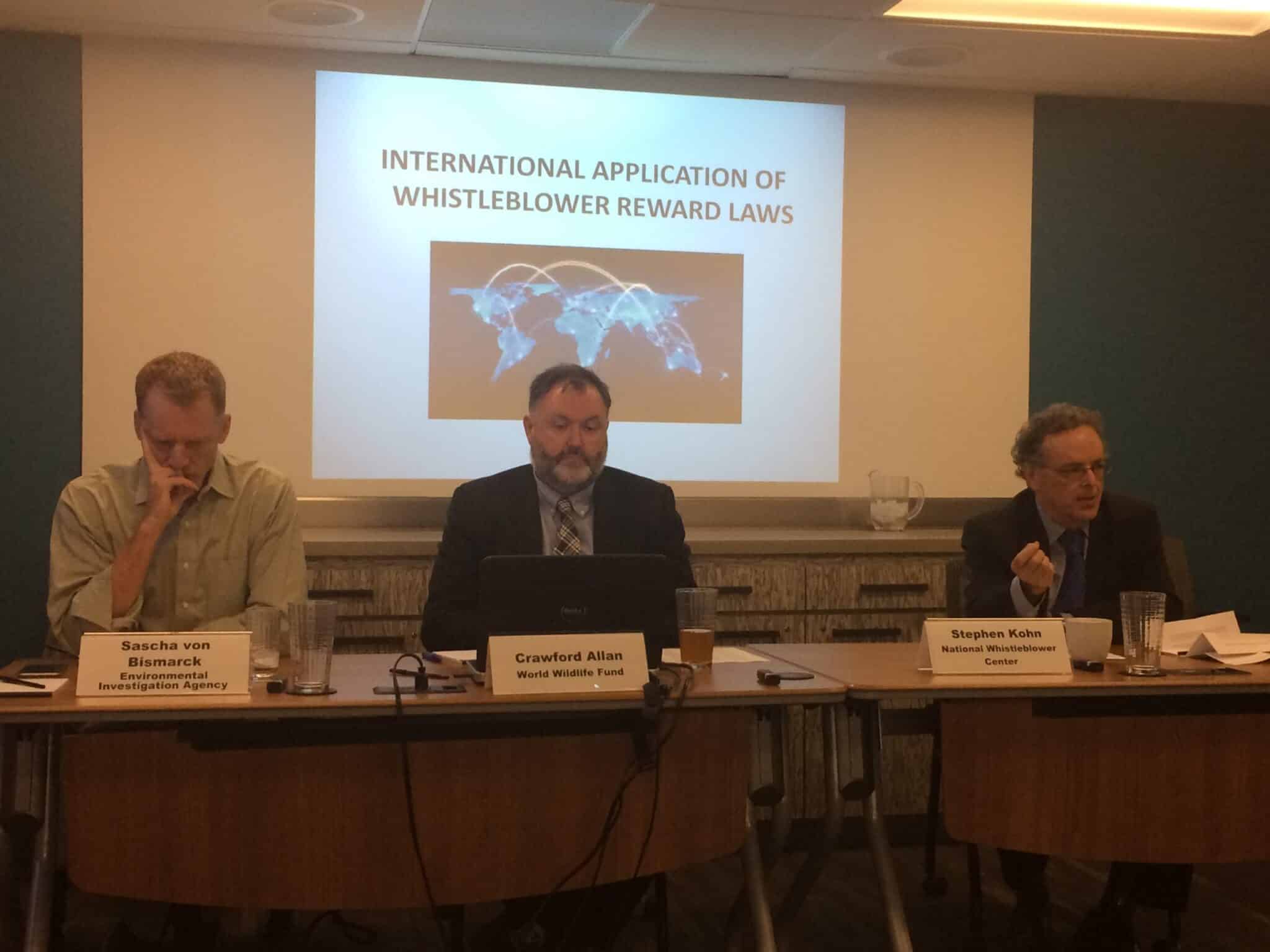
On Friday, July 23, 2010, the National Whistleblower Center (NWC) hosted a seminar on the False Claims Act2010-07-23 NWC Seminar on FCA and Dodd-Frank that included a special presentation on the Dodd-Frank Wall Street Reform and Consumer Protection Act that was recently signed into law. Stephen M. Kohn, Executive Director of the National Whistleblower Center, gave the presentation on the new financial regulations and whistleblower protections outlined in the new law. 

Along with creating better financial regulations to prevent problems on Wall Street that have affected the nation, the bill also includes better whistleblower protections and increases the statute of limitations for retaliation claims under the False Claims Act to 3 years. The bill has created two new qui tam provisions for commodities and securities exchanges, thus providing employees who witness fraud the ability to report it and sue on behalf of the government. The bill also closes a loophole in the Sarbanes-Oxley Act, assuring coverage for whistleblowers employed by subsidiary companies. Mr. Kohn stated that this bill might possibly be the single most important whistleblower protection law in the United States, aside from the First Amendment and the False Claims Act. 

After the presentation on the Dodd-Frank bill, Michael Kohn, NWC President, David Colapinto, NWC General Counsel, and Tony Munter, an NWC Attorney, gave a presentation on the False Claims Act and how to integrate it into one’s law practice. They gave a run-down of the steps involved in screening clients with potential False Claims Act cases and the steps involved in filing and litigating such a case.

If you are an attorney and would like to be added to the NWC's list for notification on upcoming events, please contact Lindsey M. Williams at lmw@whistleblowers.org. The full agenda and written materials from the seminar are available here.   

*Phil Shank (NWC intern) drafted this post.

Upcoming Seminar: Integrating the False Claims Act Into Your Law Practice

The False Claims Act is the most powerful federal whistleblower law. Unfortunately, attorneys and their clients often miss the opportunity to file a claim, because they lack knowledge of the law's unique requirements and procedures. This seminar will provide an introduction to the law to help an attorney determine both how and whether to file a claim. This seminar will take place on Friday, June 11, 2010 from 12:00 pm - 3:00pm EST. Attorneys can participate in-person at the National Whistleblowers Center office, located in Washington, D.C., or via teleconference.  

To view the seminar faculty and bios, click here. For seminar agenda, click here 

Register now online, or mail a check payable to the National Whistleblowers Center to 3238 P Street NW, Washington, DC 20007. 

Free Seminar on OSHA Whistleblower Program

Professionals for the Public Interest will host the event “Whistleblowers and OSHA: Strengthening Professional Integrity” on May 11th from 11:45 a.m. to 2:00 p.m. at the American Association for the Advancement of Sciences (AAAS). The event is free and open to the public with advance registration. The presentation will feature the Assistant Secretary of Labor for Occupational Safety and Health David Michaels, PhD, MPH. Dr. Michaels is nationally recognized for protecting the scientific integrity on which the health and environmental policies are based. Participants will also discuss the Whistleblower Protection Program in the Office of Safety and Health Administration. The event invitation gives some interesting prompts, such as “How is the Whistleblower Protection Program working now?” “How do its challenges relate to its responsibilities across so many statutes and industries?” In order to register for this thought-provoking seminar, click here.

NWC Seminar on Whistleblowers and the Media available on C-SPAN

C-SPAN aired today's National Whistleblowers Center (NWC) seminar on Whistleblowers, Lawyers and the Media.  It is available on C-SPAN online. The seminar features insights about some of the most famous whistleblower cases in the media, and general comments about what whistleblowers should know before talking with the media.  The panelists include Rich Bonin (a producer for 60 Minutes), Jim Popkin (formerly of NBC Nightly News and now with Seven Oaks Media Group), John Solomon (formerly of the Washington Post, the Washington Time, the AP, and now with the Center for Public Integrity) and Stephen M. Kohn (Executive Director of NWC).  The seminar covered key strategies and laws for spotlighting whistleblowers in the media. Here is a photo of Rich Bonin and Stephen Kohn and the seminar:

Bonin and Kohn 20100401


For whistleblowers considering whether to go to the media or not, watching this seminar would be an excellent way to learn about issues one should consider.  For example, these journalists have the impression that whistleblowers tend to be "persnickety" or "gruff." After all, they reason, it is their unwillingness to go along with misconduct that makes them whistleblowers in the first place. While I might find this assessment to be a generalization, all whistleblowers should be mindful of how they come across so they can attenuate their presentation to a journalist. Showing a willingness to listen to the journalist's questions, answering them directly, and avoiding interruption could go a long way to helping the journalist to bond to you and your cause. The panelists agree that for each story they do based on whistleblower information, their could be two or three times as many that they turn away.

Rich Bonin said that whistleblowers he has worked with are all motivated by altruism. Bonin said that whistleblowers still need to be prepared for a counterattack. If you are challenging rich or powerful interests, such as the government, they are going to use their resources to find damaging claims to make against you. "Being a whistleblower is never easy," Bonin says, "but is has value."

Because adversaries will go after whistleblowers with a fine-toothed comb, journalists need to do that too.  They need to find what the other side will find, before they find it. Obviously, this is easier for the journalist if the whistleblower can just be open about what the other side might find or say. When blowing the whistle on the federal government, be mindful that agencies have access to personnel files, including background investigations of those with security clearances. While privacy laws generally prohibit release of this information, it is not unusual for information to leak out when agency heads want it to leak out. Whistleblowers suffer from social isolation after they blow the whistle. They are used to working on something important, and then they get ignored or shunned.

John Solomon of the Center for Public Integrity presented "Seven Principles for Working Together." By understanding the difference between speaking "on" or "off" the record, or "on background," whistleblowers can avoid misunderstandings about what the journalist will print. Journalists want facts, accurate and new facts. Whistleblowers need to expect that the journalist will check and verify facts before printing them. So, come to the table with facts, and with information about how to verify them.

Steve Kohn discussed how his firm won a whistleblower case against the Savannah nuclear weapons facility just by going to the media.  At the time, there was no legal protection for whistleblowers in the nuclear weapons industry. When a hearing was called, attorney Michael Kohn decided to walk out without presenting any witnesses, on grounds that the rules for the hearing did not provide due process. Then, the Washington Post started with a page 3 story about hazards at the facility. Plant management overreacted and fired one of the witnesses. Then the Washington Post ran a page 1 story! That led to action by the Secretary of Energy, the Inspector General, and an order for reinstatement.  This is a rare case, and whistleblowers cannot expect to see it repeated.

Jim Popkin of the Seven Oaks Media Group answered a question about how investigative journalists will be able to sustain themselves in this era of cutbacks. He mentioned a web page where members of the public can read about investigative projects and make contributions.  Here is the link to the Knight News Challenge selection of Spot.us. When asked how to sustain a journalist's interest in a story, Jim explained that sustaining interest is the job of advocates, not journalists. Journalists report what is new, and it is not their job to repeat it for the sake of obtaining a desired result. Whistleblowers need to have realistic expectations of what a journalist can do.

Michael Kohn reported on a case where media attention had an undesired effect.  After the 9/11 terrorist attacks, he worked on a story about how the NRC had known about the risks of an air attack on nuclear power plants. Once the story got out, the concern became focused on the accessibility of information about these dangers. The result was that NRC removed information from its web pages, and the public lost an opportunity to access information that could hold officials accountable.

John Solomon is working through the Packard Media Group to encourage news editors and producers to accept the public responsibility to continue investigative journalism, and to recognize ways in which it can still be profitable, if it is done the right way. "It is such an important part of democracy," he says.

Epoch Times has released a story about this seminar.


NELA training on appellate advocacy, Dallas, March 12-13

The National Employment Lawyers Association (NELA), is presenting "Effective Appellate Advocacy In Employment Cases." Using a mock case, the seminar will feature workshops on brief writing and oral argument. This program will be held on March 12 - 13, 2010, at the Crowne Plaza Hotel Dallas Downtown, in Dallas, Texas. Use this link to register now.


"No matter who wins below, a lot of employment cases wind up on appeal. In the twelve months ending September 30, 2008, about one out of every eight employment cases wound up on appeal. Settlement value is influenced by how the parties thought the case would turn out if it were litigated all the way up to an appeal." - Rick Seymour

This program will equip plaintiffs' employment lawyers with the necessary skills and tools to represent their clients successfully in the appellate courts. This skills-based training seminar will examine strategies and practical tips in preparing for, writing, and arguing employment cases at the appellate level. Topics include:

* preserving your evidence and arguments in the trial court;
* strategies and techniques for effective brief writing;
* preparing for and structuring your oral argument;
* the use of moot courts; and
* when to seek assistance from appellate specialists and amici curiae.

Important Dates:

* The member rate of $500 has been extended! Register now and save $150 off the on-site rate.


* The last day to take advantage of the seminar hotel rate of $129 per night for single and double occupancy is Friday, March 5.

Upcoming Training Seminar to Focus on National Security

The National Whistleblowers Legal Defense & Education Fund will host a conference call training seminar covering a number of innovative and alternative ways to successfully represent national security employees. The three presenters, Mark S. Zaid, Stephen M. Kohn, and David K. Colapinto, all seasoned litigators in this field, will focus on a number of legal tools including constitutional injunction, Title VII, the Privacy Act, FBI whistleblower procedure, and whistleblower laws protecting national security contractors.

The information that will be covered is valuable to any national security whistleblowers, anyone who represents these clients in their practice, or any advocate dedicated to preserving the rights of national security employees.

The teleconference will take place Friday, December 11, at 12:00 p.m. Eastern/9:00 a.m. Pacific.
Click here for registration information.

Special Conference Call for Attorneys Wednesday September 30th

Bookmark and Share


In response to the many requests from our Attorney Referral Service (ARS) members and non-members looking for advice on whistleblower protection cases, the National Whistleblower Legal Defense & Education Fund will hold a two-hour telephone conference call on Wednesday September 30th from 10:00 am – 12:00 pm (EST) conducted by leading attorney experts.  This is the ideal way for attorneys to get answers to your tough questions about whistleblower protection, case strategies, legal remedies and laws.

NWC Special Counsel Dean A. Zerbe was recently added to the faculty for the call to address tax and False Claims Act questions.  Mr. Zerbe was active in Congressional investigations of government waste, fraud and abuse for over 25 years.  Mr. Zerbe left Congress in 2008 where his last position was as Senior Counsel and Tax Counsel on the Senate Finance Committee for Senator Charles E. Grassley. In his work for Senator Grassley, Mr. Zerbe was the driving force behind the drafting and passage of legislation that created the Whistleblower Office at the IRS as well as changes in the tax code that greatly expanded the rewards for tax whistleblowers. In addition, Mr. Zerbe was closely involved with the False Claims Act on behalf of Senator Grassley - who is the author of the modern False Claims Act/Qui Tam.

Faculty also includes Stephen M. Kohn, National Whistleblowers Center (NWC) Executive Director, Michael D. Kohn, NWC President, David K. Colapinto, NWC General Counsel, and Richard R. Renner, NWC Legal Director.

SIGN UP TODAY FOR THIS SPECIAL CONFERENCE CALL OPPORTUNITY!

For more information please click here.

        DATE:    Wednesday September 30, 2009

        TIME:     10:00 am - 12:00 pm (EST)

        COST:    $50 for ARS members
                        $250 for Non-ARS members
   
SPECIAL NOTE: You can join the Whistleblower Attorney Referral Service (ARS) today (1 yr. membership is $195.00) and receive your ARS Member discount by calling us at 202.342.1903, or registering online.

You can sign-up online or mail your check to today:
 MAKE CHECKS PAYABLE TO: NWLDEF
(National Whistleblowers Legal Defense & Education Fund)
Send to: 3238 P Street, NW, Washington, DC 20007

***ARS Members contact Estelle S. Kohn at ek@whistleblowers.org or (202) 342-1903 for the discount code prior to registering online.  Refunds cannot be made after the fact. ***
 

*Faculty Subject to Change
 

National Whistleblowers Center Announces the First Training Seminar Covering Whistleblower Rights Under the Newly Enacted Consumer Product Safety Act of 2008


Protections Expanded to Workers Who Expose Safety Defects in Imported Consumer Products and Violations of the Consumer Products Safety Act and the Hazardous Substances Acts


Washington, D.C. November 8, 2008.  The National Whistleblower Center is sponsoring the first training seminar covering the newly enacted whistleblower protection provisions of the Consumer Product Safety Act of 2008.   The new law contains groundbreaking whistleblower protections covering millions of workers employed in the manufacture, distribution, and sale of consumer goods. The Act contains strong pro-employee provisions, including the right to a trial by jury, compensatory damages and attorney’s fees and costs.

The all-day seminars are being held in the Taft Room at the Willard InterContinental Hotel,
1401 Pennsylvania Ave., N.W. Washington, D.C. on November 21, 2008.  

The new law protects workers who blow the whistle on safety problems in over 15,000 different types of consumer products, including Asbestos, benzene, bicycle helmets, blasting caps, carpets and rugs, caustic or corrosive substances, 
flammable products, 
fabrics, 
fireworks, gasoline, 
toxic substances, 
imported consumer products, lead paint, and 
toys.   The protections extend beyond the Consumer Products Safety Act, an include disclosures concerning violations of the Federal Hazardous Substances Act, the Flammable Fabrics Act, and the Poison Prevention Packaging Act.

This is the first seminar specifically designed to train whistleblowers and their advocates in the mechanics of the Act, and how this law would protect workers who blow the whistle on toxic toys and other dangerous consumer products.    Commencing at 9 a.m., the program consists of four seminars covering all aspects of the new law.  It is designed to assist workers and their lawyers in effectively presenting claims.  CLE credit is available to attorneys.   

To review the full program and faculty click here A registration fee of $495.00 is required, but scholarships are available.  Whistleblowers, students, community activists, and members of the press who wish to attend should contact 
Estelle S. Kohn
  at  202-342-1903 or email her at  ek@whistleblowers.org