
SIGN UP NOW
Follow the NWC on Twitter!Follow the NWC on Facebook!

Newsweek Reports on Whistleblower Handbook Library Donations

Today, Newsweek’s The Daily Beast announced that whistleblowers from across the country are donating a new how-to guide to local public libraries. So far, the whistleblowers have donated a thousand copies, which is only the beginning if their idea takes off. 

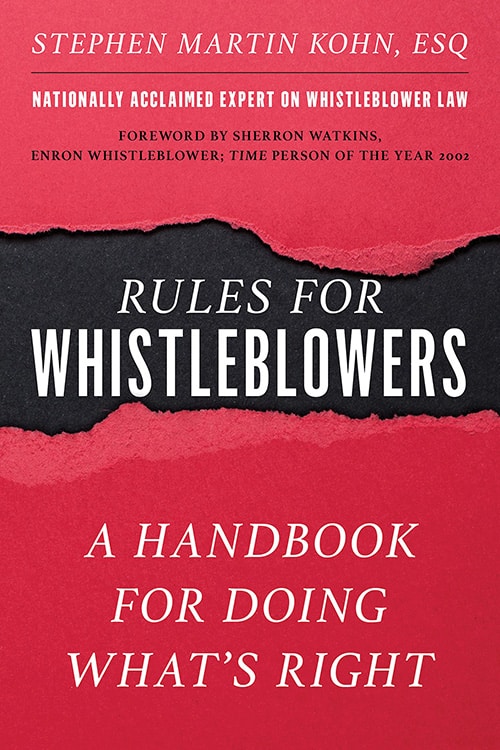
Written by the NWC’s very own Stephen M. Kohn, The Whistleblower Handbook: A Step-by-Step Guide to Doing What’s Right and Protecting Yourself has received staunch praise from whistleblowers who have already fought through their cases. John Solomon of The Daily Best describes Mr. Kohn as, “a feared litigator in government and corporate circles, who wins three quarters of the cases he brings on behalf of aggrieved whistleblowers.”

Frederic Whitehurst, who blew the whistle on the FBI crime lab in the 1990s, came up with the library project and was interviewed for the Newsweek article. “With whistleblowers, if they lose their case, they lose their credibility, and that means they can’t fix the wrong they want to right. So this really is about citizen empowerment,” he explained. “Where do people go and what can they do to make change and have a major impact when they know of something wrong.” 

Dr. Whitehurst, Solomon reports, “would do it all again, [but] doesn’t want future whistleblowers to make the same mistakes he did.” This sentiment is shared among the 20 whistleblowers who are sending the Handbooks to libraries. They have all used their own money for the donations, hoping to “inspire Americans to blow the whistle on the next Enron-sized corporate fraud, a potentially devastating nuclear- or drug-safety issue, or the ethical transgressions of a government leader–but to do it in a way that saves them some of the heartache [they] endured.”

You can find the full list of 20 whistleblowers who have joined the cause, including Bunny Greenhouse, Sibel Edmonds, Robert Smith, Dr. David Lewis, and Linda Tripp, in the National Whistleblowers Center press release.

If you would like to join the whistleblowers’ initiative by donating a Handbook to a public library, click here.

*Owen Dunn (NWC Fellow) drafted this posting

Whistleblowers: From the American Revolution to WikiLeaks

On July 25, 2011, one of the nation’s leading whistleblower attorneys, Stephen M. Kohn, will share compelling insights from his newly-released book, The Whistleblower’s Handbook: A Step-by-Step Guide to Doing What’s Right and Protecting Yourself at the Mid-Manhattan New York Public Library. The author talk and book signing will be hosted by “Author @ the Library,” from 6:30 pm to 8:30 pm. This is a unique opportunity to gain invaluable knowledge from one of the foremost experts in whistleblower rights, free of charge.

The Whistleblower’s Handbook is the first-ever step-by-step guide to whistleblowing and protecting your rights. Within its pages, Kohn lays out twenty-one clearly defined steps on how to effectively blow the whistle while protecting oneself. These vital steps will be shared in our author talk, in an effort to educate the public about employee rights. Attendees can also expect to learn about how the latest federal and state laws can be used to achieve full whistleblower protection and monetary rewards.

Mr. Kohn will also discuss his New York Times op-ed, “The Whistle-Blowers of 1777,” which detailed the plight of the first American national security whistleblowers. Based on the final chapter of The Whistleblower’s Handbook, this piece tells the story of sailors who blew the whistle on misconduct by the first Commander of the United States Navy. Rather than persecuting the whistleblowers for threatening “national security,” the Continental Congress sided with the sailors and acted swiftly to protect their rights. The Congress’s prompt and undisputed response is a far cry from how modern-day administrations treat whistleblowers today, such as the recent prosecution of Bradley Manning and Thomas Drake by the Obama Administration.

Take advantage of this chance to learn more about the history of whistleblowing and gain insight on whistleblower protection laws. The event is open to the public, so be sure to show up early to guarantee yourself a seat.

*Cho Hwang (a NWC intern) contributed to this posting

Kohn Op-Ed in New York Times tells the story behind America's first whistleblower protection law

Stephen M. Kohn, Executive Director of the National Whistleblowers Center (NWC), published an op-ed article in today's New York Times.The article tells the story of Captain John Grannis, and nine other sailors of the Continental Navy. The full story is contained in The Whistleblower's Handbook. The actual documents from the Continental Congress are linked here.

These courageous sailors and marines petitioned the Continental Congress to relieve the commander of the Continental Navy, Commodore Esek Hopkins. The sailors reported that Hopkins had engaged in misconduct including, the torture of British prisoners of war.

On March, 26, 1777, the Continental Congress accepted the petition and suspended Hopkins as leader of the Navy. he would later be formally discharged.

Hopkins was politically connected, and he retaliated immediately against America's first whistleblowers. He filed a criminal libel case against the whistleblowers in Rhode Island's court. Samuel Shaw, a midshipman, and Richard Marven, a third lieutenant, were detained during the proceedings. On July 23, 1778, they pleaded to Congress that they had been “arrested for doing what they then believed and still believe was nothing but their duty.”

Without any recorded dissent, Congress declared:

That it is the duty of all persons in the service of the United States, as well as all other inhabitants thereof, to give the earliest information to Congress or any other proper authority of any misconduct, frauds or misdemeanors committed by any officers or persons in the service of these states, which may come to their knowledge.

Congress did not stop there. It also authorized payment for the legal fees of Marven and Shaw. Kohn calls this act "America’s first whistle-blower-protection law." With the help of attorney William Channing, the whistleblowers won an acquittal.

Kohn points out that today's America does not go so far in protecting whistleblowers. The Obama Administration is detaining and prosecuting Bradley Manning for allegedly releasing documents to WikiLeaks. It also prosecuted Thomas Drake for disclosing mismanagement of the National Security Administration (NSA) to the Baltimore Sun. Today's whistleblowers have no protection when they lose their security clearance, and employees of the NSA and CIA are excluded from the Whistleblower Protection Act (WPA).

Kohn's article is a fitting tribute to the First Amendment on the fortieth anniversary of the day the New York Times began publishing the Pentagon Papers.

NWC Executive Director will hold an open forum on April 10th

On Sunday April 10, 2011, Stephen Kohn, Executive Director at the National Whistleblowers Center, will be available at 5:00 pm (EST) for an online chat forum at Firedoglake’s Book Salon. The topic of this book salon will be The Whistleblower’s Handbook.

For two hours Mr. Kohn will be holding an open discussion on The Whistleblower’s Handbook: A Step-by-Step Guide to Doing What’s Right and Protecting Yourself (Lyons Press 2011).

Everyone will have the opportunity to post questions and comments regarding The Whistleblower’s Handbook as well as any whistleblowing issues. Mr. Kohn will provide real-time responses during the two-hour time frame.

The Whistleblower’s Handbook is the first-ever consumer guide to whistleblowing. In The Whistleblower’s Handbook, Mr. Kohn explains nearly all federal and state laws regarding whistleblowing. In the step-by-step bulk of the book, he also presents the following twenty-one rules for whistleblowers:

Rule 1: Understand the Maze

Rule 2: Follow the Money

Rule 3: Yes, You Are a Whistleblower

Rule 4: Find the Best Federal Law

Rule 5: Don't Forget State Laws

Rule 6: Always Ask: Is the Taxpayer on the Hook? 

Rule 7: Check for Tax Cheats, the IRS Qui Tam

Rule 8: Know Dodd and Frank: Securities and Commodities Qui Tam Claims

Rule 9: If Working for the Government, Use the First Amendment

Rule 10: Make Sure Disclosures Are Protected

Rule 11: Beware of "Hotlines"

Rule 12: Cautiously Use "Self-Help" Tactics

Rule 13: Be Prepared for the Lid to Blow

Rule 14: Delay is Deadly, 158 Rule

Rule 15: Get the Proof Needed to Win the Case

Rule 16: Get to the Jury

Rule 17: Win the Case: Prove Motive and Pretext

Rule 18: Get Every Penny Deserved

Rule 19: Make the Boss Pay Attorney Fees

Rule 20: Don't Take "Hush Money"

Rule 21: Never Forget: Whistleblowing Works


Log in or make an account now to participate in the online forum on April 10th!


For more information on The Whistleblower’s Handbook, visit the NWC new online store.


Links:

Register for The Whistleblower’s Handbook Book Salon

Click here for more information on Stephen Kohn


*Sabeen Khanmohamed (a NWC intern) contributed to this posting


Whistleblowers host book signing party for Stephen Kohn

Fourteen whistleblowers hosted a book signing party last night for Stephen Kohn's new book, The Whistleblower's Handbook. Pictured here are:  Jane Turner, Jim Murtagh, Bunnatine "Bunny" Greenhouse, Dr. Marsha Coleman-Adebayo, Bill Sanjour, Russell Tice, Kiki Ikossi, Jim Bobreski, Dr. David L. Lewis, Tom Hunter, Linda Tripp, Marita Murphy, Dr. Frederic Whitehurst, and Bassem Youssef.

Whistleblower hosts

You can still buy The Whistleblower's Handbook for $16.95, plus shipping and handling. More pictures follow in the continuation of this blog entry.

Cheryl and Fred Whitehurst, Jane Turner

Cheryl and Fred Whitehurst and Jane Turner. 


 FBI whistleblowers

 FBI whistleblowers Jane Turner, Bassem Youssef and Fred Whitehurst.


Linda, Mike, Bunny & Bill

Linda Tripp, Michael Kohn, Bunny Greenhouse & Bill Sanjour


Hap Barko

Hap Barko and Michael Kohn


Bunny and Bassem

  Bunny Greenhouse and Bassem Youssef


Dave & Marita

David Colapinto and Marita Murphy


Lindsey Williams and Ardie Griffin

 Lindsey Williams and Ardie Griffin


 EPA whistleblowers Dr. David Lewis, Dr. Marsha Coleman-Adebayo and Bill Sanjour.


Steve and Mike Kohn

Steve and Mike Kohn


Top Ten Things You Should Know Before You Blow the Whistle

Article Reposted from the Corporate Crime Reporter (March 9, 2011)

Whistleblowing is a hot area of legal practice.

Why?

Well, whistleblowing can mean big money for the corporate defense attorney, for the whistleblower, and for the whistleblower’s lawyer.

There is of course the False Claims Act – which has secured $27 billion in recoveries to the U.S. Treasury – and delivered $2.8 billion in bounty payments to citizens who have successfully blown the whistle on corporate crooks stealing from the government.

And there is the newly enacted Dodd-Frank whistleblower provision which promises similar millions to citizens who report violations of the Foreign Corrupt Practices Act (FCPA) – among other laws.

Even the IRS has a program that rewards whistleblowers who blow the whistle on tax frauds.

Just yesterday, a copy of The Whistleblower’s Handbook by Stephen Kohn was dropped by our office.

Whether you are a corporate crime defense counsel, a worker thinking on turning in your crooked boss, or a whistleblower’s lawyer – we recommend you pick up this book.

But until you do, we have distilled it and come up with the Top Ten Things You Should Know Before You Blow the Whistle.

Number Ten: Whistleblowing is More Effective than Regulation in Controlling Corporate Crime. PriceWaterhouseCoopers interviewed 5400 CEOs, CFOs, and CCOs from nearly every major global corporation. Key finding: Whistleblowers are the most effective source of information in both detecting and rooting out corporate criminal activity.

Number Nine: Don’t Delay. You might have the best case in the world – worth tens of millions to the government and millions to you. But if you don’t file it on time, it could be worth nothing. Delay is deadly.

Number Eight: Be Prepared for All Hell to Break Loose. “Whistleblowers need to be prepared,” Kohn writes. “If they think blowing the whistle will automatically win them a grand prize, they should think again. They need to understand the serious nature of whistleblowing, the impact it may have on their career and family, and the necessary steps that they may take to protect themselves.”

Number Seven: Embrace Your Inner Whistleblower. “I am not a whistleblower – I was only doing my job!” That is something you will commonly hear from whistleblowers. Kohn says that “no one takes the job intending to become a whistleblower.” But sooner or later, you’re going to have to embrace your inner whistleblower – or you will be in trouble. “Without accepting this change in status, employees cannot begin to take the crucial steps to protect their careers.”

Number Six: Don’t Take Hush Money. After bringing a case, the corporation might try and buy you off. One famous case involved Brown & Root in 1987 and a journeyman electrician, Joseph Macktal, Jr. Macktal was fired from the Comanche Peak nuclear power construction site in Stevensville, Texas for raising safety concerns. “Brown & Root wanted his silence and was willing to pay,” Kohn writes. “Macktal’s attorneys wanted their fees and strongly urged him to accept the money offer.” He did. But the settlement – which included a gag order – “ate at Macktal’s conscience.” He eventually hired new attorneys and successfully challenged the settlement agreement.

Number Five: Beware of Hotlines. Big corporations often set up hotlines, with toll free numbers, and urge employees who witness wrongdoing to call the number and report the “concern.” Should a whistleblower do it? Like the hotline programs themselves, Kohn is conflicted. The hotline programs “empower the fox to police the chickens,” he writes. “But they can also put the company on the spot. They force the company to live up to its commitment to transparency and accountability.”

Number Four: Don’t Take Legal Advice from a Corporate Compliance Officer. “Compliance officers and hotline investigators work for the company – they do not work for the employees,” Kohn says. “They are under no obligation to inform employees of their rights or the laws that may protect them.”

Number Three: Be Skeptical about Corporate Confidentiality. “It is well known that the very nature of an employee’s complaint can act to ‘fingerprint’ the worker,” Kohn says. “Often, only a small group of workers are aware of the details concerning a regulatory violation.” When a corporate official commences his or her review of the complaint, “it is often not difficult for the employer to figure out the identity of the whistleblower.”

Number Two: Don’t Break the Law. Remember, if you are a whistleblower, you are blowing the whistle on the corporate law breakers. You don’t want to be caught breaking the law while whistleblowing. “This is a basic rule that must be followed,” Kohn says. “If a court determines that an employee broke a criminal law in order to obtain evidence in the case, the employee will suffer a sanction. The case may be dismissed, the employee’s credibility will be attacked, and there may even be a referral for a criminal prosecution.”

Number One: Follow the Money. According to Kohn, this is the single most important rule. “Four major federal laws provide for the payment of reward to whistleblowers who can prove that their employers committed fraud,” Kohn writes. “These rewards can be large.” I think this translates into – make sure you pick a lawyer who knows what law delivers the most bang for your career – which you are about to flush down the toilet.

Kohn is executive director of the National Whistleblower Center. For the past 25 years, he’s been in the trenches fighting the whistleblower wars. The lessons learned from those wars have been distilled in this book.

And he poses two questions to his fellow Americans:

“If you think your boss may be a crook, if you think there may be safety violations at work, if you think your managers are cheating in tax payments, violating terms of government contracts, committing financial frauds, or violating the law, should you just stay silent?” he asks. “Or should you figure out whether or not you could be a potential whistleblower, and then carefully determine what to do when the boss may be a crook?”

Solution Zone discussed The Whistleblower's Handbook

NWC Executive Director Stephen M. Kohn was Christiane Brown’s guest on The Solution Zone. They discussed Mr. Kohn's new book, The Whistleblower’s Handbook.

You can listen to the archived show on Progressive Radio Network by clicking here.

You can purchase your own copy of The Whistleblower's Handbook and help support the work of the National Whistleblowers Center by visiting our new online store.

Standing Room Only at Whistleblower's Handbook Launch

Stephen M. KohnLast night, leading whistleblower attorney and Executive Director of the National Whistleblowers Center, Stephen M. Kohn, held an author talk and book signing for his new book The Whistleblower’s Handbook: A Step-by-Step Guide to Doing What's Right and Protecting Yourself, also released that day.

The talk at Busboys and Poets had a standing room only turnout. It was co-sponsored by the National Whistleblowers Center, Teaching for Change and the Zinn Education Project. Michael D. Kohn, NWC President, and Deborah Menkart, Teaching for Change Executive Director, spoke up for whistleblower advocacy and the importance of Stephen Kohn’s new handbook. Stephen Kohn was described as one of the “finest lawyers that money can’t buy.”


Busboys groupDr. Marsha Coleman-Adebayo, Director of the No FEAR Coalition and an Environmental Protection Agency (EPA) whistleblower introduced Stephen Kohn. Dr. Coleman-Adebayo stressed the importance of being appropriately educated before taking on a whistleblower case because the laws are difficult to understand and navigate. ” Paving the way for Stephen Kohn to discuss the importance of The Whistleblower’s Handbook, Dr. Coleman-Adebayo noted the deep irony that U.S. government officials “praise whistleblowers in Egypt and Tunisia but not here in the U.S."

Mr. Kohn began his talk by explaining why he wrote a handbook that lays out the rules in language for the public at large. Having represented whistleblowers for 27 years, has been an enriching, but often heartbreaking experience. Mr. Kohn often sees distraught employees come into his office explaining what they witnessed. Although their accusations had merit, the whistleblowers often lost by stepping on procedural landmines due to the confusing whistleblower laws.

According to Mr. Kohn, “The law doesn’t care if you’re right or wrong. The law is the law. You have to be prepared from Day One.”

After introducing The Whistleblower’s Handbook, the floor was open to questions and comments from the audience. Mr. Kohn answered all questions patiently and thoroughly. For example, he addressed questions as broad as the status of whistleblower protections for all Americans and as specific as the origins of the False Claims Act.

It took Mr. Kohn nearly five years to write his seventh book. He said that this was by far the most difficult book to write because of its significance. He broke down whistleblower legislation into language easy for all to understand. With that goal in mind, The Whistleblower’s Handbook has 21 comprehensive rules with examples of successful and unsuccessful cases. The National Whistleblowers Center applauds Mr. Kohn’s dedication to whistleblowers.

You can purchase your own copy of The Whistleblower's Handbook and help support the work of the National Whistleblowers Center by visiting our new online store.


*Sabeen Khanmohamed (a NWC intern) drafted this posting.

Washington Times and FSN discuss importance of The Handbook

Why is Bradley Birkenfeld serving a forty-month prison sentence for giving up his career in private banking and netting billions of dollars in lost tax revenue for American taxpayers?

The answer was simple, according to Birkenfeld’s lawyer and the Executive Director at the National Whistleblowers Center, Stephen M. Kohn. His mistake was walking into the wrong office in Washington DC, the criminal division of the US Department of Justice.

Kohn said the most important step in cases where ordinary citizens step forward to reveal fraud is “who you blow the whistle to and what you say.”

 The Washington Times discusses The Whistleblower’s Handbook: A Step-by-Step Guide to Doing What’s Right and Protecting Yourself, Stephen M. Kohn’s newest released book. The article notes some of the book’s contents such as information on viewing “hotlines” with discretion.

Feature Story News (FSN) Reporters Blog also posted about The Whistleblower’s Handbook, explaining that ways to attain generous rewards for uncovering wrong-doing are revealed in the book.

The Whistleblower’s Handbook is the blueprint whistleblowers need to be prepared from day one.

To purchase the book, please visit the NWC Store.


Links: 

The Washington Times "Whistleblowing handbook points up some serious pitfalls" (PDF version)


*Sabeen Khanmohamed (a NWC intern) contributed to this posting


First-Ever Guide For Whistleblowers Released Today

Today is the official release of The Whistleblower's Handbook: A Step-by-Step Guide to Doing What's Right and Protecting Yourself. This book finally answers that question: how do you blow the whistle the right way? Renowned whistleblower attorney and author Stephen M. Kohn, explains all major federal and state laws protecting whistleblowing.  He relies on his 27 years of experience representing many of America's most important whistleblowers to set forth twenty-one basic rules that every potential whistleblower needs to know. The Whistleblower's Handbook is the authoritative reference for anyone who has ever wondered how they might blow the whistle -- and, once they've done so, how to prevail.

Please read the review of The Whistleblower's Handbook posted today by Charlotte Yee on her blog Government Accountability is a Citizen's Responsibility.  

 
TONIGHT March 1st

6:30 to 8:00 p.m.

Author Talk and Book Signing

Busboys and Poets
Langston Room
2021 14th Street, NW
Washington, DC 20009


You can find out more about The Whistleblower's Handbook and order your copy ($16.95 plus shipping) to support the work of the National Whistleblowers Center by visiting our website.

We hope to see you at Busboys and Poets!

The Whistleblower's Handbook Archives