
SIGN UP NOW
Follow the NWC on Twitter!Follow the NWC on Facebook!

FBI keeps agent who botched Stevens case and hounds out the whistleblower

Alaska DispatchThe Alaska Dispatch published a story yesterday that reveals how the Federal Bureau of Investigation (FBI) condones misconduct and punishes those who speak out for the truth. The story by investigative reporters Amanda Coyne and Tony Hopfinger is called, "Why is the lead agent in the botched case against Ted Stevens still working for the FBI?" The lead agent in question is Mary Beth Kepner.  The whistleblower is Chad Joy, who was Kepner's partner during the 2008 Stevens investigation.  In an eight page whistleblower disclosure, Joy alleged that Kepner (1) hid information that Stevens' legal team should have been entitled to review, (2) leaked grand jury testimony of a government witness, (3) didn't document interviews, (4) acted inappropriately with sources, and (5) failed to properly document for a judge an application for a wire tap. Joy alleged that the prosecution also failed to disclose evidence and transported a witness back to Alaska to make him unavailable to testify at the trial. Coyne and Hopfinger reference a newly released Department of Justice report that confirmed Kepner's misconduct in the Steven's investigation. The report is dated August 2011. Kepner is still on the job at the FBI.  

The Stevens' case was Joy's first case as an FBI agent.  "I don't want to be punished for coming forward," he wrote. In 2009, the FBI removed him from all criminal cases. Coyne and Hopfinger say this, "effectively end[ed] his career." In early 2010, he resigned. Meanwhile, the U.S. Attorney's office in Anchorage, Alaska, launched an investigation led by Frank Russo. Russo found that Kepner's lapses were minor, and then nitpicked Joy's work.

Stephen M. Kohn, Executive Director of the National Whistleblowers Center, told Coyne and Hopfinger that Russo's investigation into Joy's complaint was illegal. Kohn explained that  procedures require investigations to be forwarded to the Inspector General for the Department of Justice. DOJ officials refused to answer Coyne and Hopfinger's questions about the Russo investigation.

"This all very troubling. If someone blows [the whistle] on an issue, they are going to face retaliation," Kohn said. "Part of the defense is always to discredit the witnesses. That's why it's necessary to take the whistleblower case out of the hands of the locals. Kohn called for the Inspector General to look into Joy's original complaint and begin an investigation into how the complaint itself was handled.

FBI rules bar a supervisor from taking retaliatory action against a whistleblower. Kohn said that because Joy's whistleblower memo helped trigger the investigation -- one that ultimately led to Stevens essentially be exonerated -- the review of the charges and the decision to take him off of criminal cases was a "retaliatory action."

Former FBI agent and NWC board member Jane Turner also suffered retaliation. She blew the whistle on agents who took mementos from Ground Zero following the 9/11 terrorist attacks. She won a jury verdict against the FBI over her treatment.
Turner said that agents who violate the FBI's code of silence are undercut and isolated. "They do everything they can to get you to quit" she said.

When you blow the whistle on the FBI, "it's death by a million paper cuts," she told Alaska Dispatch.

FBI training scandals raises concern for whistleblowers

By Guest Blogger: Jane Turner
Member of NWC's Board of Directors and Director of NWC's FBI Oversight Program

Recently, an article appeared in Wired magazine reporting that the Federal Bureau of Investigation (FBI) was teaching that being a devout Muslim is in itself a sign of terrorist activity. The article exposed teaching techniques used at the FBI Academy in Quantico, Virginia. Teaching materials for FBI counterterrorism agents were replete with portrayals of American Muslims in a negative light. The article noted “...FBI whistleblowers provided Danger Room with these materials.”

My immediate attention went to the FBI employees who are still brave enough to put their careers on the line to speak the truth. The Director of the FBI, Robert S. Mueller III, has positioned himself in public and private as a leader who will not retaliate against FBI whistleblowers.

The reality, however, has been that Director Mueller and his senior managers have done their best to discredit, retaliate, humiliate, threaten, and launch reprisals against FBI personnel who try to bring misconduct or criminal behavior to light. Previously, two of Mueller’s closest senior management team, Assistant Director Robert Jordan and Executive Assistant Director W. Wilson Lowry took retaliatory action against Unit Chief John Roberts. They advised Roberts that they considered his whistle blowing activities a personal insult. They invoked the well worn screed about the “FBI family” which is code for keeping everything in house, and noted Director Mueller agreed with their assessment. This is the modern version of the “code of silence” that has long kept the public in the dark about police misconduct.

Dr. Frederic Whitehurst, who provided well founded criticism of the FBI laboratory, suffered ostracism, gag orders and a stunted career. Both Roberts and Whitehurst had family members working at the FBI who were exposed to retaliation. Every single FBI whistleblower has been punished in some way, from the loss of their career, to the loss of their reputation. Not one single whistleblower has been honored, or recognized by the FBI. Instead, each has been vilified.

Corrective action has never been taken against those officials who have participated in retaliation and reprisals against FBI whistleblowers. Most are promoted into the rarified air of Senior Executive Service, the highest paying jobs in the FBI. Nothing will fast track your advancement inside the agency then retaliating against a whistleblower. This insidious handling of whistleblowers serves to send a discouraging message to employees who consider speaking the truth. It results in a chilling effect that discourages agents from using official channels to raise concerns about misconduct by their superiors. Some whistleblowers have learned to find outside avenues, like leaking to the media.

I notified superiors of misconduct by fellow FBI Agents who had stolen artifacts from ground zero after 9/11. That was the beginning of my long, torturous journey, culminating in the FBI preparing termination papers for my dismissal. After twenty five years of honorable and distinguished service, I was constructively discharged. My performance review noted that I had “embarrassed” the FBI, which again, was code for not protecting the FBI's image.

I eventually prevailed in the courts. So have other whistleblowers who challenged FBI management before judicial and administrative entities. Together, we have showed the world that the FBI retaliates. Director Mueller's reaction has been to ramp up the FBI’s vast legal resources to block, obfuscate, and delay justice for whistleblowers. Director Mueller is taking the role of Captain Ahab with whistleblowers as his Moby Dick. His personal vendetta against whistleblowers borders on obsession. Whistleblowers are compelled by a moral compass and driven by an ethical makeup to speak truth to power.

The FBI whistleblowers who provided information and documents to Wired magazine are a direct result of Director Mueller’s war on whistleblowers. By using weapons of retaliation, humiliation, discreditation and repudiation; by threatening, demeaning, and bankrupting those who report wrongdoing; by forcing whistleblowers into a bureaucratic maze, the FBI has pushed whistleblowers to use the media instead of official channels.

President Obama's decision to give Director Mueller a two year extension to continue the war on terror also results in the continuation of Director Mueller’s war on FBI whistleblowers. If Director Mueller and his management team launch a hunt to identify and the whistleblowers who leaked this story to Wired magazine, they will problably find FBI employees with distinguished and unblemished service records. It is the FBI's smartest and most courageous agents who tend to become its whistleblowers. It is a pattern exemplified by John Roberts, Frederic Whitehurst, Bassem Youssef, Sibel Edmonds, John Cole, Robert Kobus, Mike German, Robert Wright, John Vincent, Gilbert Graham, Colleen Rowley and myself.

Congress is currently considering the Whistleblower Protection Enhancement Act (WPEA) to modernize the legal protections for federal employees who risk their careers to expose waste, fraud and corruption. The administration and its allies are seeking to exclude from this bill all the employees of national security agencies, including the FBI. Please, let us not forget the the courageous whistleblowers who have sacrificed their careers to protect the public. Please, let the WPEA protect all federal employees.

Newsweek Reports on Whistleblower Handbook Library Donations

Today, Newsweek’s The Daily Beast announced that whistleblowers from across the country are donating a new how-to guide to local public libraries. So far, the whistleblowers have donated a thousand copies, which is only the beginning if their idea takes off. 

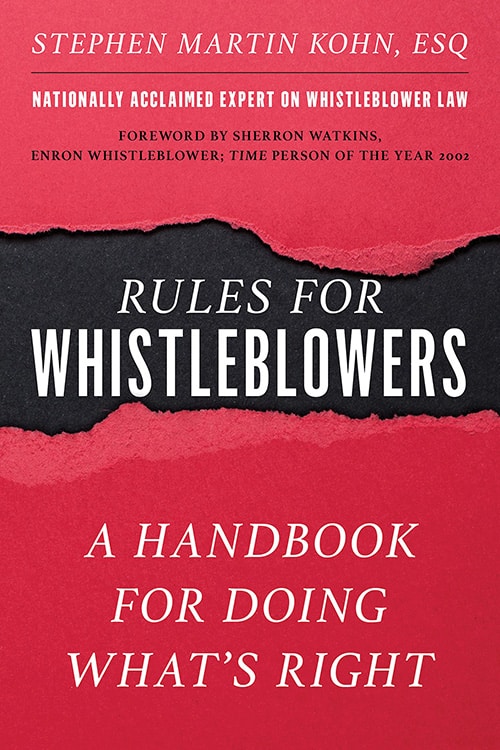
Written by the NWC’s very own Stephen M. Kohn, The Whistleblower Handbook: A Step-by-Step Guide to Doing What’s Right and Protecting Yourself has received staunch praise from whistleblowers who have already fought through their cases. John Solomon of The Daily Best describes Mr. Kohn as, “a feared litigator in government and corporate circles, who wins three quarters of the cases he brings on behalf of aggrieved whistleblowers.”

Frederic Whitehurst, who blew the whistle on the FBI crime lab in the 1990s, came up with the library project and was interviewed for the Newsweek article. “With whistleblowers, if they lose their case, they lose their credibility, and that means they can’t fix the wrong they want to right. So this really is about citizen empowerment,” he explained. “Where do people go and what can they do to make change and have a major impact when they know of something wrong.” 

Dr. Whitehurst, Solomon reports, “would do it all again, [but] doesn’t want future whistleblowers to make the same mistakes he did.” This sentiment is shared among the 20 whistleblowers who are sending the Handbooks to libraries. They have all used their own money for the donations, hoping to “inspire Americans to blow the whistle on the next Enron-sized corporate fraud, a potentially devastating nuclear- or drug-safety issue, or the ethical transgressions of a government leader–but to do it in a way that saves them some of the heartache [they] endured.”

You can find the full list of 20 whistleblowers who have joined the cause, including Bunny Greenhouse, Sibel Edmonds, Robert Smith, Dr. David Lewis, and Linda Tripp, in the National Whistleblowers Center press release.

If you would like to join the whistleblowers’ initiative by donating a Handbook to a public library, click here.

*Owen Dunn (NWC Fellow) drafted this posting

NWC Responds to Letter from Whistleblowers

Yesterday, the National Whistleblower Center (NWC) received a letter from whistleblowers concerning our position on the Senate version of the Whistleblower Protection Enhancement Act (S. 372).  Please take the time two read the two response letters.  The first letter is from Dr. Frederic Whitehurst and Jane Turner, two FBI whistleblowers and members of the NWC's Board of Directors.  The second letter is from NWC Executive Director Stephen M. Kohn

NWC RESPONSE TO LETTER FROM WHISTLEBLOWERS (PDF Version)

Dear Whistleblowers:

Thank you for your letter received on December 13, 2010 concerning S. 372 and the position of the National Whistleblower Center. Given the importance of obtaining proper protection for federal employees, I understand and respect the concerns you have raised. I also welcome the opportunity to state our position on these issues. 

The actual differences of opinion on S. 372 developed in the summer of 2009. At that time the NWC was part of the "Steering Committee" of the Make it Safe Coalition (MISC). We were fully engaged in a series of face-to-face meetings at the Old Executive Office Building with representatives from the White House. In response to a survey circulated by the NWC during the 2008 presidential election, a number of candidates (including then candidate Barack Obama, Hilary Clinton, Ron Paul, among others) had pledged to support H.R. 985. This bill had passed the House of Representatives with a strong bi-partisan majority, was fully supported by the whistleblower community and contained true due process rights for all federal employees.

At a meeting I attended, the White House counsel/representative specifically stated that President Obama would not adhere to his promise to support H.R. 985, and that the White House did not care if we accused them of breaking their promise. I was startled. But what followed was worse. The White House proposals for federal employees were a major step backward. The White House proposals for federal employees were a major step backward. Yet they were being sold as advancement, and promises of a White House celebration were in the air. 

As the negotiations progressed, it became clear that the White House and the Senate had formulated a proposal that was radically different from the H.R. 985, and that many of the White House/Senate proposals were in fact rollbacks from current legal rights. 

We could not accept this. At the end of July, 2009 the Senate Homeland Security Committee "marked-up" S. 374.   The bill was terrible. But the MISC Steering Committee issued statements in support of the bill, and praising the White House for its contributions, when in fact those contributions were counterproductive and dangerous.

At that time we were compelled to voluntarily resign our membership in the MISC Steering Committee (although we remain members of the MISC itself). In September, 2010 I wrote a series of 12 blogs on S. 372. Our concerns were well known to all. 

After we opposed S. 372, negotiations commenced to fix the bill. Although not a part of the Steering Committee, we worked hard to fix the bill, and some of our suggested compromises were adopted. Of the twelve major problems we had identified in the blogs, five were fixed. We were also informed by the Steering Committee that the overall strategy was to have the Senate pass the bill, but have the problems with the bill fixed in a conference with the House. 

Shortly before Thanksgiving, a newspaper reporter told me that the Senate bill was about to be approved by Unanimous Consent, and that the House leadership had agreed to approve it, without any changes. Furthermore, I was informed that the White House and the MISC Steering Committee were all in support of this process. 

No one informed us of this change in strategy, except a reporter at the last minute. Additionally, the MISC Steering Committee refused to provide us with a copy of the Senate bill that was about to be approved. We objected to this process, and demanded to see a copy of the bill. Eventually, a source not connected with the Senate staff or the MISC provided us with a copy of the bill after the MISC Steering Committee asked groups to express support for approval of S. 372 without changing a word. 

After reviewing the Senate bill, it became clear why those supporting the new strategy of blind House approval did not share the bill with us. The bill still contained two serious rollbacks of current whistleblower rights, and other compromises that significantly weakened many of its positive features. The bill was a Trojan Horse. Along with the National Security Whistleblowers Coalition and the Federal Ethics Center, we published our views on the bill, linked here.

With this as background, let me address some of your major concerns:

1) “S. 372 is like a good modern dam that will undoubtedly have flaws and require routine maintenance."

The bill contains more than just "flaws," it rolls back important rights. Our main concern is not just that the bill is not "good enough," it is that specific "poison pills" were inserted in the law at the behest of (a) the White House and (b) some of the most anti-whistleblower Senators, that repeal current rights. These are not just flaws. From our perspective, these rollbacks should have been vigorously and aggressively attacked from the start. It is just plain wrong to use an "Enhancement Act" to actually rollback significant whistleblowers rights. The right to protection for raising any violation of law and the right to a hearing are core principles of federal employee whistleblower protection.

2) "For years there were no controls in place to prevent the abuse of information designations to hide embarrassing mismanagement . . ."

When the Civil Service Reform Act was originally passed in 1978, whistleblowers had the right to blow the whistle on "mismanagement." This was a good part of the law.

However, in 1989, as part of the WPA of 1989 "enhancements" advocated by many whom today aggressively support S. 372, that definition was changed. Employees lost their right to blow the whistle on "mismanagement." The term was changed to "gross mismanagement." As a result, the ability of employees to obtain protection for blowing the whistle on mismanagement was dealt a devastating blow.

Significantly, in the Drake decision (which will be further discussed), the Federal Circuit pointed the finger at Congress for creating the "gross" standard qualifying "mismanagement." The Federal Circuit justified some of its bad decisions on that definition.

The Enhancement Act does not fix this. The qualifications on protected disclosures remain, and only disclosures of "gross" mismanagement and "gross" waste of funds are protected. 

Worse, as fully explained in our letter to Congressional leadership, the Enhancement Act seriously compromises the ability of employees to blow the whistle even on violations of law. 

S. 372 actually reverses one of the most important pro-whistleblower decisions issued by the Federal Circuit. In the Drake case, the Merit Systems Protection Board weakened or qualified the rights of federal employees to blow the whistle on violations of law in a manner consistent with prior Circuit Court rulings on gross mismanagement; however, the Federal Circuit in Drakereversed the MSPB and upheld the right to blow the whistle on violations of law without the qualifications urged by the MSPB and federal agency management. 

By reversing the Drake decision, which upheld whistleblower rights to report violations of law, S. 372 would require the Federal Circuit to apply the case law it developed interpreting "gross mismanagement" in cases concerning disclosures of violations of law. Please review our letter to the key Congressional offices for a full explanation of this major problem.

3) "Right now more than ever, S. 372 needs to get passed and the Administration should consider the resurrection of the careers of past whistleblowers who drowned in the raging river."

Passing S.372 has nothing whatsoever to do with forcing the Administration to help whistleblowers who have already been harmed. Even if helpful, the terms of the bill only apply to new cases filed 30 days after the bill is signed into law.

The NWC has always supported making the reform legislation retroactive to September 11, 2001. We have also supported inserting specific provisions into the law that would address some of the more outrageous decisions issued in the past ten years that have harmed employees who have tried to do the right thing and we have repeatedly urged the Obama administration to undertake a review of past cases to reverse unjust dismissals of whistleblowers. 

Unfortunately, S. 372 will not help anyone who lost their case.

If the administration is serious about correcting past wrongs, it is long past the time to start doing that. It is irresponsible for the White House or others to hold out false hopes to whistleblowers, that if they somehow support S. 372, there may be a review of individual cases. This is an odd manner of horse-trading rights. In any event, as an attorney who represents many employees who were harmed by the terrible provisions in the current law, and some of the terrible decisions of the prior administrations, there has been no indication that the White House is serious about addressing injustices created under prior administrations. In fact, we are currently engaged in litigating against the current administration in regard to retaliation that has occurred (or is being continued) under the new White House.

3A) "Frankly, you have been invisible to us when there was still time during this year." 

We have worked tirelessly to try to: (a) fix the Senate bill; and (b) urge the House to hang-tough in the negotiations. For your information, the MISC Steering Committee had asked us to back-off on our public campaigns on this issue, in deference to their inside-negotiation strategy. We accommodated that request, until we learned that the new strategy included a process in which the most serious problems in the Senate bill would not be fixed (or even addressed) by the House. NWC does not advocate an all or nothing approach and was willing to support a reasonable compromise. Unfortunately, the choice presented by the Senate and the White House is to support a bill that rolls back rights and harm whistleblowers or do nothing. We have continually advocated both publicly and privately to Congress that the most serious mistakes and problems in S. 372 that set back whistleblower rights must be fixed. 

3B) "We dismiss your suggestion that it is possible to get stronger legislation through the next Congress as baseless." 

I do not believe that the NWC ever stated a belief that the next Congress would be better, we simply stated that all hope would not be lost in the next Congress because whistleblower protection is a bi-partisan issue. After a very careful review of S. 372 as a whole, it is our professional opinion that the costs of the legislation outweigh the benefits. This conclusion is based primarily on the inclusion of two major "roll-backs" on whistleblower rights. 

4) In regard to one of these roll-backs, you state as follows: "One is about a technical rollback of whistleblower rights against ‘trivial illegality’ that was only shrunk to irrelevance, not completely eliminated. Now at worst it would only apply in a factual scenario that never has come up in any case since 1994. It is too bad this loophole was not canceled outright. But we are more worried about rolling back the Federal Circuit case law used to end our careers in hundreds of decisions of Federal Circuit and MSPB decisions during that time period."

Unfortunately, this statement demonstrates that the community still does not understand the significance of the Enhancement Act's roll-back on the definition of a protected disclosure. 

First, you state that our concern was focused on a "technical rollback" that "was only shrunk to irrelevance, not completely eliminated."

The change in the scope of protected disclosures is not merely "technical." It is a major substantive provision that will cause havoc in real-life cases, and will lead to even more unjust dismissals. The change in definition actually conflicts with current statutory merit system principles, and Executive Order and years of good case law. The way this provision materially harms whistleblowers is set forth in our letter to Congressional leadership.

Second, you state that you "are more worried about rolling back the Federal Circuit case law used to end our careers." But the case at issue here was not used to "end" anyone's career. The Drake case, which the Enhancement Act will statutorily reverse, is one of the very few cases in which a whistleblower actually prevailed in a lawsuit. The Federal Circuit ruled for this employee from the bench, and ordered corrective action. Sadly, S. 372 reverses that important precedent.

It is strange that the Enhancement Act would undermine one of the only safe-harbors existing in federal whistleblower law (i.e. the unqualified right to blow the whistle on any violation of law), and would overturn one of the only pro-whistleblower decisions. 

Indeed, just think of how the MSPB, the Federal Circuit and other courts will view this so-called "enhancement." How will they interpret the Congressional intent behind the Enhancement Act when the law actually reversed one of the Federal Circuit’s only pro-whistleblower decisions?

5) In regard to summary judgment, you state that the new authority given to the MSPB to summarily dismiss employee cases is not a major concern because "the MSPB already has a hybrid summary judgment system." 

Make no mistake about it. The MSPB does not have summary judgment authority, and once it gets that authority, every whistleblower case will be seriously and irreparably harmed. 

First, a little history. Before 1978, federal employees could bring whistleblower cases in federal court under Bivens and they had other court access rights that were extinguished when the Civil Service Reform Act was passed. In 1978, when federal employee whistleblower rights were established under the Civil Service Reform Act, there was a hot debate over giving the MSPB summary judgment powers. As part of the compromises reached, Congress rejected the attempt to give this power to the MSPB. See H.R. Rep. 95-1717, 95th Cong. 2d Sess. 137 (1978).

Thus, this issue has been around since 1978, and under the Enhancement Act, the "community" is apparently ready to forfeit a major right that was obtained in 1978.

Second, executive agencies have, for years, tried to use the Federal Circuit as a vehicle for obtaining summary judgment authority. They have, on numerous occasions, strongly urged the Federal Circuit to approve such authority. The Federal Circuit has rejected these requests. See, e.g., Crispin v. Dept. of Commerce, 732 F.2d 919, 922 (Fed. Cir. 1984).

Thus, what the White House and federal agency management could not obtain from Congress in 1978 or from the Federal Circuit, they are now going to get through an Enhancement Act.

Third, do not confuse the MSPB's current process of dismissing cases at the "jurisdictional" level, with summary judgment. In federal court there are two gate-keeping procedures. The first is a motion to dismiss. If, on the face of your complaint, you simply cannot win, you case can be dismissed. The second is summary judgment.  The MSPB’s long practice of requiring whistleblowers to demonstrate jurisdiction at the initial phase of a case is more analogous to responding to a motion to dismiss than it is to summary judgment.

A strong employment case usually survives a motion to dismiss, as the standards to obtain dismissal are very high.

But summary judgment is much different.   Giving this new power to MSPB will result in a substantial increase in litigation costs in whistleblower cases, a decrease in the ability to obtain settlements and the creation of a "record" that will be very difficult to reverse on appeal. Many cases will be dismissed by MSPB under this new power.

6) It is unfortunate that you have attacked the NWC's motives, and essentially accused us of being greedy lawyers. Although that may be an easy stereotype, our record speaks for itself and this type of discussion is not productive. 

An example of NWC’s record in this area is an award received by NWC’s Advocacy Director, Lindsey Williams, “for demonstrating her commitment through POPULAR to helping poor and other disadvantaged people access affordable and competent legal representation, important civil and criminal justice system reforms, as well as appropriate judicial oversight.”

Read more: http://www.prweb.com/releases/prweb2010/12/prweb4840764.htm

After S. 372 is passed, whistleblowers will need lawyers. Currently, there are very few who will handle federal employee cases on an affordable, contingency fee or pro bono basis. Many of the public interest groups that support S. 372 do not provide any, let alone free, legal services to federal employee whistleblowers. When the law is passed, whistleblowers will need attorneys to represent them.

The key to obtaining representation from an attorney is for the law to be strong enough to justify a lawyer taking the case on an affordable or contingency fee basis. We fear that the problems in S. 372 will not stimulate increased private sector support for federal employees. Our recent survey of private sector attorneys reinforces this position.

Attorneys who are willing to represent federal employees are not your enemy. They have no interest in blocking a law that would help them win cases. Their interest in a strong law mirrors yours.

You also state that attorneys should move aside, and yield to the "whistleblowers" opinion of the law. The NWC is a non-profit organization, and 6 of our 13 board members are former federal employee whistleblowers. The NWC's position reflects an analysis of the law, and incorporates the legal staff’s near century of combined experience in this area to judge the actual merits of S. 372.  

7) You raise a number of points regarding the progressive provisions contained in S. 372. We agree there are some. But in our "Bad Deal" statement, we explained how many of these reforms are not as strong as they are currently being marketed. Many have loopholes. Please review this Statement for a better understanding of our position and our conclusion that the bad parts of the bill outweigh the good parts.

8) We agree that federal employees need "need stronger rights now." But the defects in the law are significant, and any progressive features are not retroactive, and will not help employees who have already filed cases or lost cases. In our considered judgment, after reviewing the bill in its entirety, we remain convinced that S. 372 is not an advance given the poison pills and limitations.

9) In conclusion, you state that "Now, we urge you to stand with us or stand aside." This dichotomy simply does not hold. The NWC's Board of Directors also consists of whistleblowers, six of whom are former federal employee whistleblowers, some of whom have current legal cases. Their voices also have a right to be heard, as do many other whistleblowers whom we assist (and who fully support our position). Free speech is needed within the whistleblower rights community. An open discussion of the relative merits of S. 372 should be encouraged and the motives of those who express their opinion that whistleblower rights will be rolled back by S. 372 should not be attacked for voicing their concerns.

We hope you recognize that the NWC is not strong enough to block this law and our aim is to fix it before it becomes law. S. 372 is supported by the federal managers lobby organization, the White House, the Senate, the majority of the MISC and now the Democratic leadership of the House. Even the most anti-whistleblower Senators (i.e. Senators who opposed many of the more progressive whistleblower laws that were recently approved) support this bill. We are flattered that many think we are "powerful" enough to block this law. This is simply not the case.

If S. 372 can get scarce floor time during the remaining lame duck session it will most likely be passed and signed into law. Although we understand this political reality, we believe that we are morally and ethically bound to voice our viewpoint.   We do not do this lightly, or to be obstructionist. We do it based on our objective analysis of the law, and the need for effective whistleblower protection. Other classes of employees have been able to obtain effective whistleblower protections in this Congress. Federal employees should not have to remain second-class citizens when it comes to the right to blow the whistle.

Respectfully yours,

Stephen M. Kohn
Executive Director
National Whistleblower Center
Washington, D.C.

December 14, 2010


NWC Board Members Respond to Letter from Whistleblowers

Yesterday, the National Whistleblower Center (NWC) received a letter from whistleblowers concerning our position on the Senate version of the Whistleblower Protection Enhancement Act (S. 372).  Please take the time to read the two response letters.  The first letter is from Dr. Frederic Whitehurst and Jane Turner, two FBI whistleblowers and members of the NWC's Board of Directors.  The second letter is from NWC Executive Director Stephen M. Kohn.

Letter from NWC Board Members Dr. Frederic Whitehurst and Ms. Jane Turner

Dear Whistleblower Community:

The National Whistleblowers Center (NWC) has received your letter.  As both members of the NWC Board of Directors and federal employee whistleblowers, we would like to respond to your concerns.

We have the highest respect for the attorneys that donate their time and services to the NWC.  Together they have over 90 years of experience representing whistleblowers across the country.  Their knowledge and expertise were instrumental in helping us win our cases, despite all odds, under the current laws.  We would not have survived without them.

The attorneys at the NWC carefully evaluated the Senate version of the Whistleblower Protection Enhancement Act (S. 372) before issuing its statements.  The National Whistleblowers Center stands by its position and believes that it is in the best interest of all whistleblowers.

We encourage everyone to read the NWC's most recent letter to the House and Senate sponsors of the whistleblower bill and the statement "S. 372: A Bad Deal for Whistleblowers" that was issued by the NWC, the Federal Ethics Center and the National Security Whistleblower Coalition. These statements are based on the NWC attorneys’ expert opinion on how the law will impact actual whistleblower cases after the victory celebrations over the law are long passed.  We ask that you carefully review the actual Senate bill and draw your own opinion.  The NWC supports the right of everyone to speak freely about whistleblower protection. However, we urge people to refrain from personal attacks that only distract from the issues at hand.

Respectfully,

Dr. Fredric Whitehurst
Director, Forensic Justice Project
National Whistleblowers Center
FBI whistleblower (Former FBI Supervisory Special Agent)

Jane Turner
Director, FBI Oversight Program
National Whistleblowers Center
FBI whistleblower (25 year veteran)

Jane Turner speaks out about the WPEA, S. 372

Jane Turner Jane Turnerhad worked as a Special Agent for the FBI for twenty years.  She led efforts to force the FBI to provide protection for child sex crime victims on the North Dakota Indian Reservations. She also reported theft of evidence from the scene of the 9/11 terrorist attacks.  In retaliation for exposing FBI failures within its child crime program, Turner was removed from her position. She prevailed in a jury trial that redressed her bad performance reviews. Her whistleblower case is still pending with the U.S. Department of Justice. 

Today Jane Turner spoke with James Corbett of CorbettReport.com.Turner  spoke about the problems with the current Senate version of the Whistleblower Protection Enhancement Act (WPEA), S. 372. CorbettReport.com provides Open Source Intelligence News. Turner explains how Title VII of the Civil Rights Act allowed her to have a jury trial to challenge her retaliatory performance review. However, a special law for FBI employees provides for a special proceeding at the U.S. Department of Justice for her whistleblower claims. Turner explains how S. 372 would take away the right of FBI agents to make whistleblower complaints like hers. Turner calls on everyone to TAKE ACTION on S. 372 to counter the power of the FBI to block whistleblower rights. The 25-minute interview is available from CorbettReport.com in MP3 format.