
SIGN UP NOW
Follow the NWC on Twitter!Follow the NWC on Facebook!

Newsweek Reports on Whistleblower Handbook Library Donations

Today, Newsweek’s The Daily Beast announced that whistleblowers from across the country are donating a new how-to guide to local public libraries. So far, the whistleblowers have donated a thousand copies, which is only the beginning if their idea takes off. 

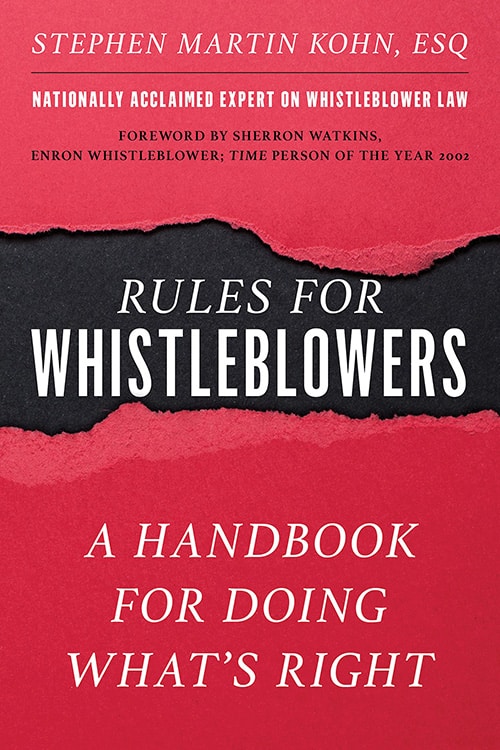
Written by the NWC’s very own Stephen M. Kohn, The Whistleblower Handbook: A Step-by-Step Guide to Doing What’s Right and Protecting Yourself has received staunch praise from whistleblowers who have already fought through their cases. John Solomon of The Daily Best describes Mr. Kohn as, “a feared litigator in government and corporate circles, who wins three quarters of the cases he brings on behalf of aggrieved whistleblowers.”

Frederic Whitehurst, who blew the whistle on the FBI crime lab in the 1990s, came up with the library project and was interviewed for the Newsweek article. “With whistleblowers, if they lose their case, they lose their credibility, and that means they can’t fix the wrong they want to right. So this really is about citizen empowerment,” he explained. “Where do people go and what can they do to make change and have a major impact when they know of something wrong.” 

Dr. Whitehurst, Solomon reports, “would do it all again, [but] doesn’t want future whistleblowers to make the same mistakes he did.” This sentiment is shared among the 20 whistleblowers who are sending the Handbooks to libraries. They have all used their own money for the donations, hoping to “inspire Americans to blow the whistle on the next Enron-sized corporate fraud, a potentially devastating nuclear- or drug-safety issue, or the ethical transgressions of a government leader–but to do it in a way that saves them some of the heartache [they] endured.”

You can find the full list of 20 whistleblowers who have joined the cause, including Bunny Greenhouse, Sibel Edmonds, Robert Smith, Dr. David Lewis, and Linda Tripp, in the National Whistleblowers Center press release.

If you would like to join the whistleblowers’ initiative by donating a Handbook to a public library, click here.

*Owen Dunn (NWC Fellow) drafted this posting

Whistleblower Dr. Aaron Westrick to Speak at ArmorCon Expo

As the research director for America’s largest body armor company, Dr. Aaron Westrick was the first official to oppose the sale of Zylon bulletproof vests. Based on his disclosures, these defective vests were forced off the market and police officers' lives were saved.  Dr. Westrick was fired and his case is still ongoing

Dr. Westrick will speak about his whistleblower experience on June 6th from 3:15 to 4:15 pm at the ArmorCon Expo in Tysons Corner, Virginia. His presentation is entitled “Combating Defective Armor: Protecting Our Warriors: The Path of a Whistleblower in the Armor Industry.” 

Press interested in attending Dr. Westrick’s presentation please contact Lindsey Williams at lmw@whistleblowers.org.

Westrick wins California appeal under state false claims act

Dr. Aaron Westrick

Dr. Aaron Westrick has won reinstatement of his claims under the California False Claims Act. Last Thursday, May 26, 2011, the California Court of Appeal for the Second District (in Los Angeles) issued its decision in State of California ex rel. Westrick v. Itochu International, Inc., Case No. B223053. On January 26, 2010, the Superior Court of Los Angeles County dismissed Westrick's complaint, holding that his complaint did not plead the allegations of fraud with specificity. The Court of Appeal has now reversed and reinstated Westrick's claims.

Dr. Westrick began his career as a police officer in Michigan. In 1982, he was shot by a fleeing burglar with a .357 Magnum from approximately five feet away. A Second Chance bulletproof vest, made of Kevlar, saved his life. Westrick subsequently earned a Ph.D. in sociology and criminal justice. In 1996, Second Chance hired Westrick as its director of research. On July 5, 2001, Dr. Westrick received a letter from the Japanese Toyobo Company stating that, “the strength of Zylon fiber decreases under high temperature and humidity conditions.” Dr. Westrick recognized that Zylon would degrade and that police officers would die while wearing "bullet-proof" vests made of Zylon. He asked his employer to recall its Zylon vests and have them tested.  In June 2003, Officer Tony Zeppetella of Oceanside, California, was killed when his $766 Zylon vest failed to stop two bullets. That same month, a police officer in Pennsylvania was seriously wounded when a bullet pierced his Zylon vest.


My colleague, Erik Snyder, presented Dr. Westrick's argument to the Court of Appeal. It was Erik's first oral argument. Based on this result, we can expect many more advances for whistleblower rights in Erik's legal career. Congratulations to Erik and Dr. Westrick.

For more information about Dr. Westrick's claims and the problems with Zylon, see this prior blog post. Some excerpts from the Court's new decision follow in the continuation of this blog entry.

From Page 10:

“The [California False Claims] Act is designed to supplement governmental efforts to identify and prosecute fraudulent claims made against state and local governmental entities by authorizing private parties (referred to as qui tams or relators) to bring suit on behalf of the government. (American Contract Services, [supra, 94 Cal.App.4th] at p. 858.)” (Hawthorne, supra, 109 Cal.App.4th at p. 1677.) The Act provides a financial incentive for private whistleblowers by entitling a successful qui tam plaintiff to share in a percentage of the recovery in the case. (§ 12652, subd. (g); Rothschild, supra,
83 Cal.App.4th at p. 495.)
The “ultimate purpose of the Act is to protect the public fisc. To that end, the Act must be construed broadly so as to give the widest possible coverage and effect to its prohibitions and remedies.” (Hawthorne, supra, 109 Cal.App.4th at p. 1677.)
The Act authorizes treble damages against one who, inter alia, “[k]nowingly presents or causes to be presented a false or fraudulent claim for payment or approval.” (§ 12651, subd. (a)(1).)

Page 15:

We conclude Westrick had pled fraud with the requisite specificity. With the above allegations in the SAC, Westrick had pled fraudulent conduct by defendants with “sufficient particularity such that [defendants are] more than able to ‘defend against the charge[s] and not just deny that [they] ha[ve] done anything wrong.’ ” (Westrick, supra, 685 F.Supp.2d at p. 137; accord Armenta ex rel. City of Burbank v. Mueller Co. (2006) 142 Cal.App.4th 636, 645 [qui tam pleading adequately “notified[d] defendants of the nature of their liability”].)

Pages 20-21:

Westrick pled sufficient facts to indicate he was an original source. Westrick alleged, inter alia, as director of research at Second Chance, he was the first employee at the company to develop a concern regarding the accelerated degradation of Zylon vests. Upon receiving the July 5, 2001 letter from Toyobo stating “the strength of Zylon fiber decreases under high temperature and humidity conditions,” Westrick determined that older vests sold by Second Chance should be pulled and independently tested in order to determine whether heat and humidity would cause them to degrade.*** The testing revealed Zylon body armor would not perform as required by the five-year warranties under which each vest was sold to police departments across the United States.

***

Westrick disclosed to the California Attorney General all the information he possessed prior to filing suit. Westrick clearly “ ‘had a hand in the public disclosure of allegations that are a part of [his] suit.’ ” (Grayson, supra, 142 Cal.App.4th at p. 755.)
We conclude Westrick sufficiently pled he qualifies as an original source within the meaning of the statute.


 

Judge approves Westrick suit against Toyobo

Federal Judge Richard W. Roberts has denied a motion to dismiss a major suit claiming the Japanese manufacturer Toyobo sold millions of dollars of defective bulletproof vests.Dr. Aaron Westrick

Dr. Aaron Westrick filed the suit under the Federal False Claims Act in 2004, and the U.S. government formally joined the suit in 2005. The suit alleges that Toyobo conspired with Second Chance Body Armor, Inc. to sell defective body armor made of Toyobo's Zylon material.

Thousands of vests were sold to police departments across the United States and the federal government. One police officer was killed and others were injured as a result of the use of defective Zylon in vests. The suit alleges that Toyobo and the companies who sold these vests knew about Zylon defects and concealed this information from their customers. The full text of a press release by the National Whistleblowers Center (NWC), with links to key documents, follows in the continuation of this blog entry.
 

U.S. District Court Judge Orders Defective Zylon "Bulletproof" Vest Case to Proceed

Evidence Supports Findings that Japanese Manufacturer Improperly Withheld Information on Product Defects from Federal Government and Police Departments

Washington D.C. February 23, 2010. Today, Judge Richard W. Roberts of the U.S. District Court for the District of Columbia denied Toyobo's motion to dismiss a major suit regarding the sale of millions of dollars of defective bulletproof vests.

Dr. Aaron Westrick filed the suit under the Federal False Claims Act in 2004, and the U.S. government formally joined the suit in 2005. The suit alleges that Toyobo conspired with Second Chance Body Armor, Inc. to sell defective body armor made of Toyobo's Zylon material. Toyobo is a large, Japanese manufacturing company, which is publicly traded on the Tokyo Stock Exchange (stock code 3101).

Thousands of vests were sold to police departments across the United States and the federal government. One police officer was killed and others were injured as a result of the use of defective Zylon in vests. The suit alleges that Toyobo and the companies who sold these vests knew about Zylon defects and concealed this information from their customers.

The court denied Toyobo's motion to dismiss on all counts. The court found evidence that "Toyobo knew and participated" in fraudulent activity, "intended to defraud buyers of Zylon vests," and "decided not to warn customers in December 2001" of the defective Zylon.

Dr. Aaron Westrick, former research director for Second Chance who blew the whistle on this dangerous fraud said, "I am grateful for this decision. Back in 2001 I asked that police departments be warned that the Zylon vests they were selling were degrading. I was ignored, threatened, harassed and eventually fired. I had no choice but to file a whistleblower case to bring these crimes to the attention of the American people. I thank the honorable police officers and the Justice Department officials who have supported my efforts to bring Toyobo to justice. My thoughts go out to Jamie Zeppetella who lost her husband Tony, and Edward Limbacher who suffered permenant injuries, both as a result of Toyobo's defective vests."

Second Chance failed to warn customers of the defective vests for over three years after obtaining multi-million dollar "rebates" from Toyobo.

Stephen M. Kohn, Executive Director of the National Whistleblowers Center and counsel for Dr. Aaron Westrick said, "The failure to warn customers of specific and direct threats to safety is a dangerous result of the predator marketing practices of these Japanese manufacturers, such as Toyobo. Not only did this company rip off the taxpayers, but it also put the lives of law enforcement personnel at risk to make a profit."


Links:

Westrick Memo from December 2001 asking Second Chance to warn customers

Decision of U.S. District Court to deny Toyobo's motion to dismiss

Background information on Dr. Aaron Westrick

Photo of Dr. Aaron Westrick (photo courtesy of whistleblowers.org)

Government sues vest maker after whistleblower's disclosures

Bookmark and Share

The U.S. Justice Department announced that it is suing First Choice Armor over its marketing of Zylon-based bullet-proof vests that the company knew would break down in heat or humidity. The suit follows disclosures by Dr. Aaron Westrick, a researcher for another manufacturer, who first opposed the use of Zylon for body protection.  Based on his disclosures, Zylon-based armor is now off the market, and officers lives have been saved.  Dr. Westrick was fired.


 The Washington Examiner has reported that the Justice Department has a 2003 email showing that First Choice's founder, Edward Dovner, knew that the vests would fail after exposure to heat and humidity.  The Justice Department is suing Dovner and his wife, Karen Herman, for transferring assets to evade the government's collection efforts.