
SIGN UP NOW
Follow the NWC on Twitter!Follow the NWC on Facebook!

Bill to Extend Whistleblower Protections to Offshore Oil and Gas Workers Introduced

On Apr 18, 2013, Rep. George Miller (D-CA) introduced bill to extend whistleblower protections to offshore oil and gas workers. Currently there is no federal law that protects oil and gas workers if they are retaliated against after they blow the whistle on workplace health and safety violations on the Outer Continental Shelf. Workers on oilrigs like the Deepwater Horizon risk losing their jobs if they report dangerous workplace conditions. The workers performing cleanup activities on the Outer Continental Shelf similarly have no protections against employer retaliation for raising health and safety concerns.

The Committee on Education and the Workforce Democrats issued a fact sheet about the Bill. The fact sheet calls for all workers to be protected when they blow the whistle on “concerns about unsafe working conditions” and to grant the workers the “right to stop working if they fear they could be injured or killed.”

“Employees are best situated to discover hazards in the work environment; they are the first line of detection and should be protected when raising concerns,” stated Stephen Kohn, Executive Director of the National Whistleblower Center. 

The Offshore Oil and Gas Worker Whistleblower Protection Act of 2013 (H.R.1649) extends whistleblower protections to employees of employers working on the Outer Continental Shelf performing oil and gas exploration, drilling, production, or oil spill cleanup.

The bill is modeled after other modern whistleblower statutes and would:

  • Prohibit an employer from discharging or otherwise discriminating against an employee who reports to the employer, or a federal or state government official that he or she reasonably believes the employer is violating the Outer Continental Shelf Lands Act (OCSLA).
  • Protect covered employees who report injuries or unsafe conditions related to the offshore work, refuse to work based on a good faith belief that the offshore work could cause injury or impairment or a spill, or refuse to perform work in a manner that they believe violates the OCSLA.
  • Establish a process for an employee to appeal an employer’s retaliation by filing a complaint with the Secretary of Labor, and allowing a jury trial if the Secretary fails to act in a timely manner.
  • Make an aggrieved employee eligible for reinstatement, back pay and compensatory and consequential damages, and, where appropriate, exemplary damages.
  • Require employers to post a notice that explains employee rights and remedies under this Act and provide training to the employees of these rights.

Read the text of the Offshore Oil and Gas Worker Whistleblower Protection Act, here.


TSA Whistleblower Robert MacLean Wins Appeal

 Robert MacLeanToday the Court of Appeals for the Federal Circuit issued a decision in MacLean v. Department of Homeland Security.  In 2003, Robert MacLean blew the whistle on the Department of Homeland Security’s Transportation Security Agency’s (TSA) plan to remove U.S. air marshals from long distance flights during a heightened terrorist alert.  Mr. MacLean was concerned that the suspension of overnight missions created a danger to the flying public. He complained to his supervisor and to the Office of Inspector General; both responded that they could do nothing. 

Mr. MacLean then gave information to a MSNBC reporter about the TSA’s plan. The reporter published an article criticizing the plan. The TSA withdrew its plan after criticism from the public and members of Congress. The TSA subsequently fired Mr. MacLean. 

A major issue on appeal from the Merit Systems Protection Board (“MSPB”), was whether or not Mr. MacLean was covered under the Whistleblower Protection Act (“WPA”). Specifically, the WPA prohibits individuals in positions of authority from taking a “personnel action” against a government employee when the employee makes a disclosure, which the employee reasonable believes to evidence a “substantial and specific danger to public health and safety, if such disclosure is not specifically prohibited by law.” The Court of Appeals held that MacLean’s disclosure was “not specifically prohibited by law.”

The Court vacated the MSPB decision which upheld Mr. MacLean’s termination and remanded the case back to the MSPB to determine whether MacLean’s “disclosure qualifies for WPA protection.” The MSPB must determine whether Mr. MacLean “reasonable believed” his disclosure evidenced a “substantial and specific danger to public health and safety.”

Read the Court of Appeals decision here

January 2013 Decisions of the Administrative Review Board

The USDOL/OALJ Reporter has published case summaries and case links for cases decided in January 2013 by the Administrative Review Board.  The decisions are found at
http://www.oalj.dol.gov/PUBLIC/ARB/REFERENCES/Caselists/01_2013.HTM

OSHA Announces Interim Rule on Whistleblower Protections for Reporting Violations of Affordable Care Act

Last Friday, OSHA published an interim final rule, and invited public comment on whistleblower protections for reporting violations of Affordable Care Act's health insurance reforms.  The Affordable Care Act contains various provisions to make health insurance more affordable and accountable to consumers. Among the policies to achieve its goals, the Affordable Care Act's Section 1558 provides protection to employees against retaliation by an employer for reporting alleged violations of Title I of the act or for receiving a tax credit or cost-sharing reduction as a result of participating in a Health Insurance Exchange or Marketplace.


The interim final rule can be viewed at www.dol.gov/find/20130222/. Comments, which will be accepted for 60 days, may be submitted electronically via the federal e-rulemaking portal at http://www.regulations.gov, or by mail or fax. Faxed submissions, including attachments, must not exceed 10 pages and should be sent to the OSHA Docket Office at 202-693-1648. Comments submitted by mail should be addressed to the OSHA Docket Office, Docket No. OSHA-2011-0193, U.S. Department of Labor, Room N-2625, 200 Constitution Ave. NW, Washington, DC 20210.

A fact sheet about filing whistleblower complaints under the Affordable Care Act is available at http://www.osha.gov/Publications/whistleblower/OSHAFS-3641.pdf.

OSHA's press release on this issue can be found here.


OSHA announces interim final rules on Seaman's Protection Act whistleblower procedures

Last week OSHA published interim final rules on the Seaman’s Protection Act procedures governing whistleblower complaints under the Act. The Seaman’s Protection Act protects seamen from retaliation for engaging in protected activity under the Act, including providing information to the government about an alleged violation of maritime safety laws or regulations.

Individuals are encouraged to review the interim final rules and submit comments about them to OSHA. Comments may be submitted in the following ways:  Submit electronically at http://www.regulations.gov, the Federal eRulemaking Portal. Submissions may also be sent via facsimile or mail. See the Federal Register notice for details. Submissions must be submitted by April 8, 2013. Faxed submissions, including attachments, must not exceed 10 pages and should be sent to the OSHA Docket Office at 202-693-1648. Comments submitted by mail should be addressed to the OSHA Docket Office, Docket No. OSHA-2011-0841, U.S. Department of Labor, Room N-2625, 200 Constitution Ave. NW, Washington, D.C. 20210.


For more information see the OSHA press release.


DOJ Considers Long Overdue FBI Whistleblower Reforms

Yesterday, the Department of Justice held a listening session with representatives of the National Whistleblowers Center, American Civil Liberties Union, Government Accountability Project and Project on Government Oversight to discuss needed improvements in the DOJ regulations that implement the Whistleblower Protection Act for FBI employees. The meeting was called as a result of a directive issued by President Obama ordering the Attorney General, in consultation with the Office of Special Counsel and FBI employees, to make recommendations to improve the effectiveness of the DOJ whistleblower program for FBI employees.

Steve Kohn and I attended the meeting on behalf of NWC and provided our insights on the weaknesses in the current FBI whistleblower program after representing several FBI employees who faced whistleblower retaliation over the past 20 years.

The NWC and ACLU also presented a briefing paper at the meeting listing 14 specific recommendations that are needed to improve the DOJ regulations on whistleblower rights for FBI employees. A copy of the briefing paper can be found here

Among the most important recommendations are changing the definition of what is a “protected disclosure” to protect FBI employees from retaliation who report wrongdoing to supervisors and for reporting through their chain of command, providing for reasonable deadlines for rulings and decisions in cases, in order to avoid the administrative delays that currently plague the program, appointing statutory Administrative Law Judges who are independent, publishing decisions in FBI whistleblower cases and making remedies and other provisions consistent with recent reforms enacted last November in the Whistleblower Protection Enhancement Act.

The Attorney General’s report to President Obama is due in April of this year. Thereafter, we expect the DOJ will announce changes to its current regulations on whistleblower protections for FBI employees through rulemaking, which will provide an opportunity for the public to submit comments on proposed rule changes.

The DOJ’s whistleblower program was non-existent in the 1990’s when Frederic Whitehurst blew the whistle on the FBI crime lab. Even though Congress had enacted a special provision within the Whistleblower Protection Act of 1989 to require the President and Attorney General to implement regulations and enforce whistleblower rights for FBI employees (5 U.S.C. § 2303), the government refused to create any FBI whistleblower program, as required by law, until after Fred Whitehurst sued President Clinton and Attorney General Reno alleging whistleblower retaliation in 1995. During the midst of that lawsuit, President Clinton ordered the Attorney General to finally create the program that Congress required be implemented in 1989.

Since the DOJ regulations were created in 1998 there have been continual problems in enforcement and many complainants have complained of administrative delay and program ineffectiveness. In addition, none of the decisions of the DOJ are published giving the FBI a distinct advantage in litigating claims to defeat FBI whistleblowers.

OSHA Files Lawsuit on Behalf of Retirement Home Whistleblower

On January 10, 2013, the U.S. Department of Labor filed a lawsuit in federal court against S.E.M. Villa II Inc., a nonprofit corporation that operates S.E.M. Terrace, a retirement facility in Milford Ohio. The lawsuit claims that S.E.M. Villa violated the whistleblower provisions of the Occupational Safety and Health Act of 1970.  The alleged violation occurred when the employer terminated a resident manager for filing a complaint with the Clermont County General Health District stating that S.E.M. Villa II had been ineffective in handling a bedbug infestation at the retirement home.

The manager was dismissed Oct. 5, 2011. The suit seeks reinstatement of the worker, in addition to an undetermined amount of back wages and benefits, and the removal of all derogatory information related to the dismissal from the worker’s employment record. The suit also seeks to permanently enjoin the employer from violating the OSH Act in the future and require that a notice be posted for employees regarding their rights under the act.

“The Occupational Safety and Health Administration is committed to protecting the rights of America’s workers who are penalized or terminated for filing complaints seeking to improve the safety and health of their work environment and those affected by it,” said Nick Walters, OSHA’s regional administrator in Chicago.

OSHA Press Release 

BNSF Railway Co. Agrees to Revise Personnel Policies That Violate Whistleblower Protection Laws

In a January 15, 2013 press release, the U.S. Department of Labor announced that OSHA and BNSF Railway Co. had reached an agreement for the company to revise personnel policies that violate the whistleblowers provisions of the Federal Railroad Safety Act and discourage employees from reporting work-related injuries.

"Protecting America's railroad workers who report on-the-job injuries from retaliation is an essential element in OSHA's mission. This accord makes significant progress toward ensuring that BNSF employees who report injuries do not suffer any adverse consequences for doing so," said Assistant Secretary of Labor for Occupational Safety and Health Dr. David Michaels. "It also sets the tone for other railroad employers throughout the U.S. to take steps to ensure that their workers are not harassed, intimidated or terminated, in whole or part, for reporting workplace injuries."

The major terms of the accord are listed in the OSHA press release.

Book Launch for NWC Board Member on October 11th

We kindly ask all of our supporters to welcome Dr. Marsha Coleman-Adebayo, NWC Board Member and EPA whistleblower, as she makes her first public appearance to launch the release of her new book No Fear: A Whistleblower’s Triumph Over Corruption and Retaliation at the EPA.

This special book talk event will be Tuesday, October 11th at 6:30 pm at Busboys & Poets (14th and V Streets, Washington, DC). Hosts of the event are Teaching for Change, TransAfrica Forum, National Whistleblowers Center, No FEAR Coalition, Alliance for Justice in the Workplace, and USDA Minority Committee. The event is free and open to the public. Please RSVP to nofearbbp@gmail.com. We look forward to seeing you all there! It truly is a remarkable story.

NWC Executive Director will hold an open forum on April 10th

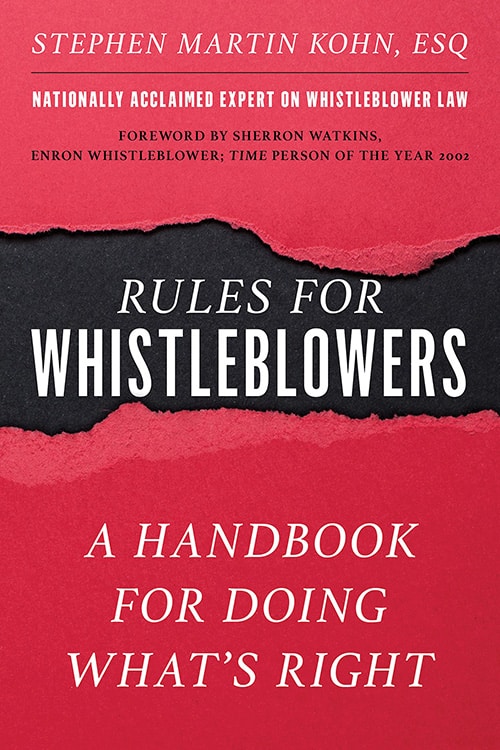
On Sunday April 10, 2011, Stephen Kohn, Executive Director at the National Whistleblowers Center, will be available at 5:00 pm (EST) for an online chat forum at Firedoglake’s Book Salon. The topic of this book salon will be The Whistleblower’s Handbook.

For two hours Mr. Kohn will be holding an open discussion on The Whistleblower’s Handbook: A Step-by-Step Guide to Doing What’s Right and Protecting Yourself (Lyons Press 2011).

Everyone will have the opportunity to post questions and comments regarding The Whistleblower’s Handbook as well as any whistleblowing issues. Mr. Kohn will provide real-time responses during the two-hour time frame.

The Whistleblower’s Handbook is the first-ever consumer guide to whistleblowing. In The Whistleblower’s Handbook, Mr. Kohn explains nearly all federal and state laws regarding whistleblowing. In the step-by-step bulk of the book, he also presents the following twenty-one rules for whistleblowers:

Rule 1: Understand the Maze

Rule 2: Follow the Money

Rule 3: Yes, You Are a Whistleblower

Rule 4: Find the Best Federal Law

Rule 5: Don't Forget State Laws

Rule 6: Always Ask: Is the Taxpayer on the Hook? 

Rule 7: Check for Tax Cheats, the IRS Qui Tam

Rule 8: Know Dodd and Frank: Securities and Commodities Qui Tam Claims

Rule 9: If Working for the Government, Use the First Amendment

Rule 10: Make Sure Disclosures Are Protected

Rule 11: Beware of "Hotlines"

Rule 12: Cautiously Use "Self-Help" Tactics

Rule 13: Be Prepared for the Lid to Blow

Rule 14: Delay is Deadly, 158 Rule

Rule 15: Get the Proof Needed to Win the Case

Rule 16: Get to the Jury

Rule 17: Win the Case: Prove Motive and Pretext

Rule 18: Get Every Penny Deserved

Rule 19: Make the Boss Pay Attorney Fees

Rule 20: Don't Take "Hush Money"

Rule 21: Never Forget: Whistleblowing Works


Log in or make an account now to participate in the online forum on April 10th!


For more information on The Whistleblower’s Handbook, visit the NWC new online store.


Links:

Register for The Whistleblower’s Handbook Book Salon

Click here for more information on Stephen Kohn


*Sabeen Khanmohamed (a NWC intern) contributed to this posting